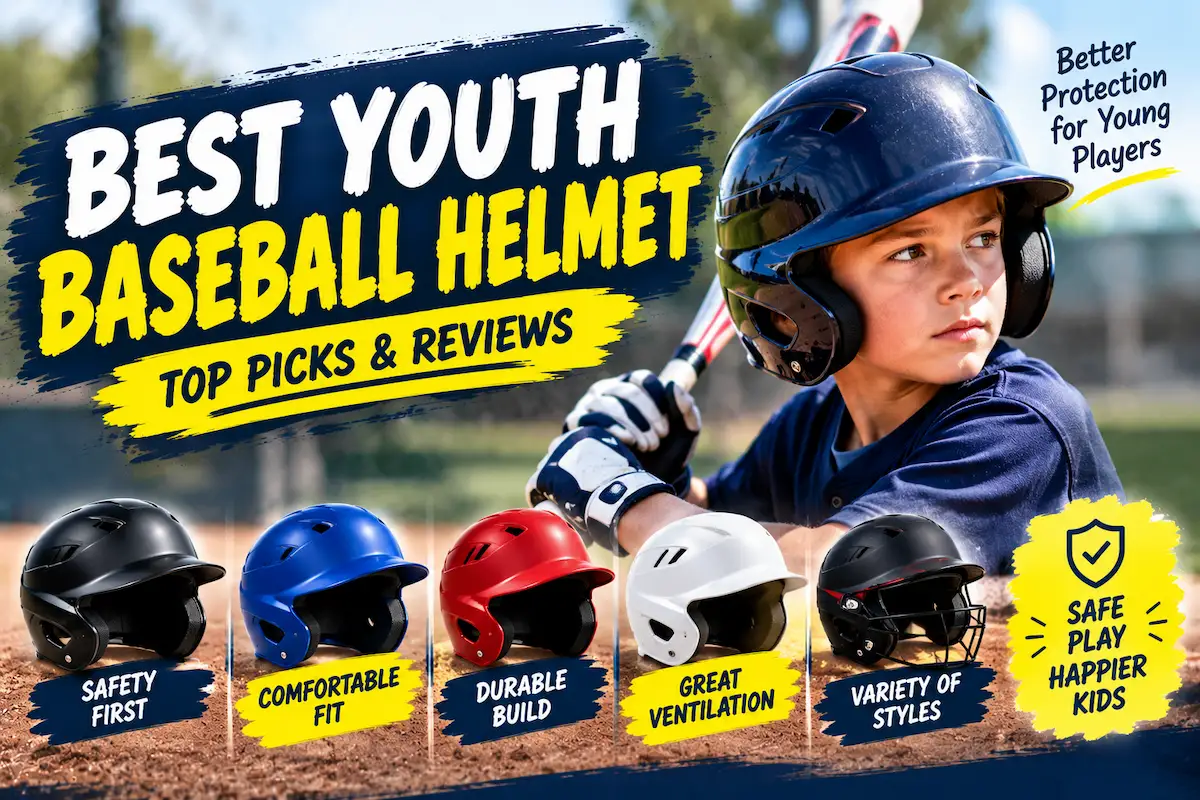
As pitch velocities in youth baseball continue to climb, a standard plastic helmet is no longer enough to protect your young batter. With travel ball pitchers throwing harder than ever and kid-pitch divisions introducing unpredictable wild pitches, choosing the right youth baseball helmet is the single most critical safety decision a parent will make this season.
However, navigating NOCSAE safety certifications, pitch-speed ratings (up to 95 MPH), and factory-integrated jaw guards (C-Flaps) can feel overwhelming. Many parents make the dangerous mistake of buying a helmet a size too big just so their child can “grow into it”—leaving them vulnerable to vision obstruction and head trauma on impact.
As a long-time coach, I’ve seen firsthand how a properly fitted, high-impact helmet builds real confidence in the batter’s box. In this updated 2026 guide, we break down the top-rated youth baseball helmets based on actual impact absorption, ventilation, sizing accuracy, and jaw-guard compatibility—ensuring your player stays completely protected every time they step up to the plate.
🛑 Coach’s Safety Warning: The “Growing Room” Helmet Trap
The most dangerous mistake parents make is buying a helmet a size too large so their child can “grow into it.” A loose helmet shifts during a swing or sprint, obstructing vision and failing to protect against impact.
- The Shake Test: Put the helmet on your child’s head and have them shake vigorously side-to-side and up-and-down. If the helmet slides or twists on the forehead, it is unsafe.
- The 1-Inch Rule: The front brim of the helmet should sit exactly 1 inch above your player’s eyebrows, protecting the forehead directly.
- NOCSAE Void Warning: Never drill home-made holes into a helmet shell to attach an aftermarket jaw guard. Altering the shell voids NOCSAE safety certification instantly. Always buy factory-approved extensions (like the Rawlings MEXT or Easton Universal Guard).
5 Best Youth Baseball Helmets With Face Guard
📊 2026 Youth Baseball Helmet Sizing & Specs Comparison
| Helmet Model | Hat Size Range | Jaw Guard | Best For |
|---|---|---|---|
| Rawlings Mach Adjust Junior | 6 3/8″ – 7 1/8″ | Included (9-Setting Adj.) | Kid-Pitch & Travel Ball (Up to 95 MPH rated) |
| Easton Z5 2.0 Junior | 6 1/2″ – 7 1/8″ | Optional / Integrated Extended | All-around comfort & moisture wicking |
| EvoShield XVT 2.0 Youth | 6 1/2″ – 7″ | Facemask or Guard Ready | Sleek, low-profile fit for mid-age youth |
| Under Armour Converge Junior | 6 1/2″ – 7 1/2″ | Pre-drilled Cage Compatible | Hot summer games (Max ventilation) |
| Easton Alpha 3.0 Youth | 6 1/4″ – 6 7/8″ | Pre-drilled for Mask | T-Ball & 8U Recreation Leagues |
⚾ 1. Rawlings Mach Adjust Junior (w/ Extension Flap)
Core Feature: The Mach Adjust is the gold standard for high-velocity safety. Built with Rawlings’ high-impact IMPAX foam tech, it absorbs and disperses force from pitch speeds up to 95 MPH. The standout feature is its 9-position adjustable jaw guard that slides forward or back without compromising sightlines.
- 9-setting adjustable jaw guard fits both right- and left-handed batting stances easily.
- IMPAX foam provides elite protection against wild pitches in kid-pitch divisions.
- Moisture-wicking liner keeps sweat out of young batters’ eyes.
- Higher price tag than basic rec-league helmets.
- Slightly heavier overall shell weight due to multi-density foam layers.
⚾ 2. Easton Z5 2.0 Junior (w/ Extended Jaw Guard)
Core Feature: The Z5 2.0 is the most popular helmet in youth baseball for a reason: durability and comfort. It utilizes a high-impact ABS thermoplastic shell lined with BioDri padded fabric that wicks moisture away instantly during hot summer doubleheaders.
- BioDri fabric liner prevents irritation and chafing on ears.
- Dual-density foam padding absorbs focal shock efficiently.
- Wide color palette to match virtually any travel team kit.
- Sizing runs snug; measure your player’s head before ordering.
⚾ 3. EvoShield XVT 2.0 Matte Youth
Core Feature: For players who dislike bulky, “mushroom-head” helmet profiles, the XVT 2.0 features a low-profile custom-fitted shell. It features compression-molded foam pads wrapped for comfort around the temples and jawline.
- Sleek, aerodynamic profile looks sharp in the batter’s box.
- SEI-certified NOCSAE impact protection.
- Seamless integration with EvoShield XVT facial guards.
- Fewer top ventilation ports than the Under Armour Converge.
⚾ 4. Under Armour Converge Junior
Core Feature: Designed specifically for hot summer doubleheaders, the Converge features large, strategically placed ventilation ports that channel airflow across the scalp. The high-impact ABS shell is backed by energy-dispersing foam padding.
- Industry-leading airflow and cooling ventilation.
- Pre-drilled holes for easy faceguard and jaw-guard installation.
- Durable liner resists odor absorption after heavy season use.
- Shell footprint is slightly wider than EvoShield models.
⚾ 5. Easton Alpha 3.0 Youth
Core Feature: The ultimate budget-friendly starter helmet for Tee-Ball, Coach Pitch, and 8U leagues. The Alpha 3.0 features an ultra-lightweight ABS shell with dual-density foam lining, ensuring young batters aren’t weighed down at the plate.
- Affordable price point without sacrificing NOCSAE safety certification.
- Extremely lightweight profile ideal for young necks and shoulders.
- Pre-drilled hardware mounts for face masks and chin straps.
- Lacks the advanced multi-density IMPAX layer found on high-velocity travel ball helmets.
What Do I Consider Every Time Buying a Youth Baseball Helmet?
Truly speaking, when it comes to choosing the best youth baseball helmet, protection is the utmost attribute to consider. If breaking down, you should dig deep into ear and face guard, chin straps, size, material, durability, etc.
Type of Helmet
The market is flooded with different types of baseball helmets. However, all that you can find are divided into something that features a face or jaw guard and some without protection.
For starters, I’ll suggest going with a guard as they are just adapting the game. After a season of rumbling around, they can also go for open-face helmets.
Must-Have Ear Guard on the Action Side
Not every day you’ll get injured. The unfortunate day comes once in a while. So, it’s wise to be prepared. Baseball batters often get hit by balls in their side head area, including the ear as this zone is exposed to the pitcher. So, make sure your helmet has an ear guard to give you the safeguard.
Having a Chin Strap is Good for Holding the Helmet Tight
Young players often struggle to hold their helmets in the right position. And chin straps are essential in this context. It enables you to get a snug fit. offering protection for the lower face area.
However, nowadays, helmets are built with liners and padding. These also secure the fitting in a comfortable way.
Right Size = Hassle-free Performance
Selecting the right size for a baseball helmet is crucial for comfort and safety. An ill-fitting helmet can hinder performance and increase the risk of injuries.
In general, the youth baseball helmets have sizes lie 6 ⅜, 6 ½, 6 ⅛, 7 ⅝, 7 ¾, 7 ¼ inches, etc. And for circumference, the common measurements are 19 inches to 21.9 inches.
To determine the suitable helmet size, measure the circumference of your head using a measuring tape. Measure from one ear to another.
Only Go ABS Plastic Made Helmets
The helmet material plays a crucial role in its performance and durability. What I’m referring to is actually the outer shell. It’s better if it’s made of ABS plastic or thermoplastic polyurethane.
These materials are higher in quality than regular plastic. Besides, these aren’t heavier than metal shells, making them good in a starter helmet.
As mentioned in my review, it’s beneficial if your helmet does have EVA foam as an inner layer. These reduce the impact shock, so the chance of injury becomes null.
To know more you can check out my Baseball Helmet Buying Guide.
🪖 Youth Helmet Matchmaker & Size Finder
Enter your player’s details to get the exact size, shell style, and jaw-guard setup needed.
Frequently Asked Questions
What helmet brand does the MLB use?
The official helmet supplier for MLB is Rawlings till now. In the last season, S100 Pro Comp was the most frequently used MLB helmet.
Do kids wear helmets in baseball?
Whether kids or adults, for every batter, it’s advised to wear a helmet in baseball. It’s for nothing but their own sake of safety
What size helmet for a 12-year-old?
For 11 to 12-year-old baseball batters, it’s recommended to use a helmet with 56 cm or 22.04 inches of circumference.
What size helmet for a 7-year-old?
Boys aged 7 should wear a batting helmet with a 52 to 54 cm circumference. And for girls, it should be 51 to 53 at max. You will get a more clear idea here: Baseball Helmet Size For 6 Year Old
🏆 Coach Jason’s Final Verdict
Never compromise on head protection to save twenty dollars. A batting helmet is the single most critical piece of safety gear your child wears on the diamond. For 2026, the Rawlings Mach Adjust Junior takes top honors for kid-pitch players due to its 95 MPH impact rating and 9-setting jaw guard. If you are on a budget or playing tee-ball, the Easton Alpha 3.0 delivers proven NOCSAE protection without weighing down young hitters.
Check out more about baseball helmets:
Youth Baseball Helmet Size Chart And Buying Guide
How to Clean a Baseball Helmet? 4 Easy Steps will Make them NEW!
How To Paint A Baseball Helmet
Hello everyone. My name is Jason Butler, and I live in California, America. I was a professional AAA Minor League Baseball player. I lost my chance of playing MLB for injury issues, but I did not lose my love for baseball. I attended the coaching training program and am now working as a coach in a small school in San Diego.
I always love to share my experience and knowledge if that can help you. Play baseball, and stay fit.