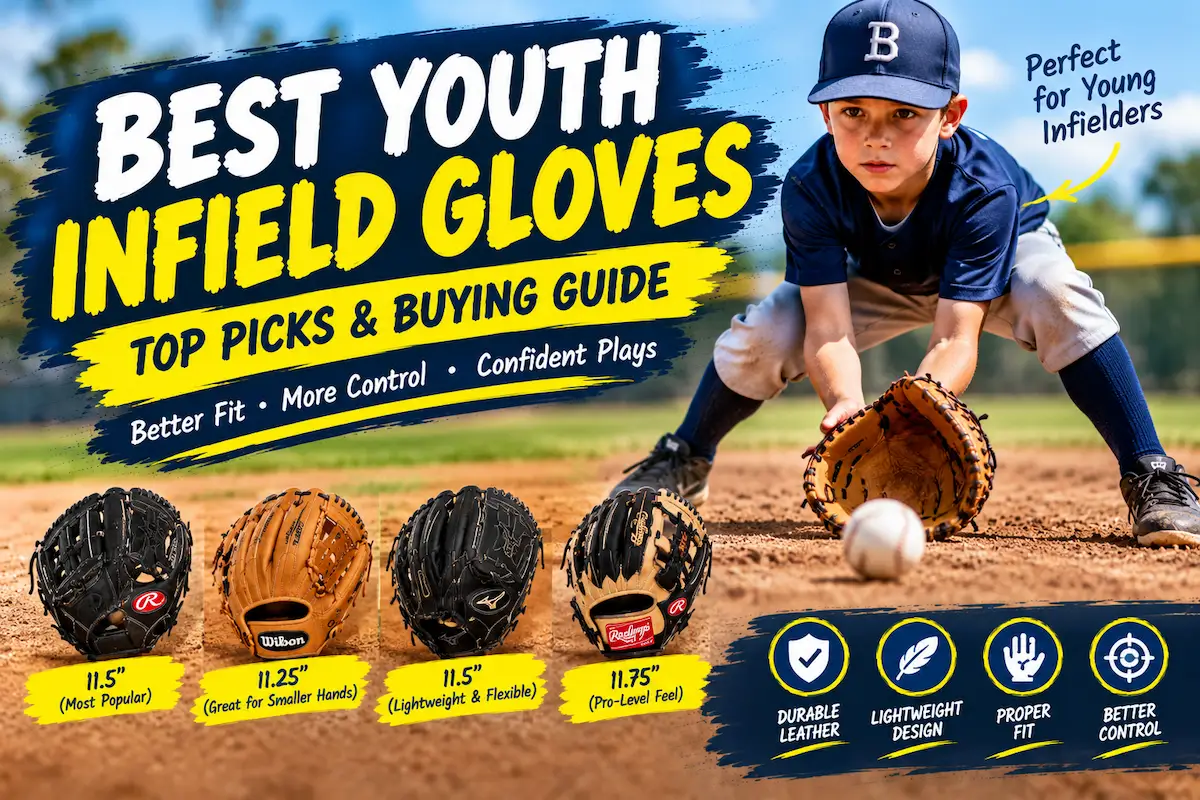
An infield glove that is too large or too stiff is the single biggest reason young middle infielders drop ground balls and struggle with quick transfers. Choosing the right youth infield glove requires balancing palm protection, soft leather, and hand-size ergonomics.
In this updated 2026 guide, we break down the 7 most popular youth infield gloves based on durability, factory break-in percentage, pocket depth, and leather quality—ensuring your player builds fast hand mechanics on the diamond.
Related: 10 Best Infield Gloves
🛑 Coach’s Warning: The “Room to Grow” Infield Trap
The most common mistake parents make is buying an adult 11.75″ or 12″ glove for an 8-year-old shortstop so they can “grow into it.” An oversized glove destroys proper fielding technique[cite: 2].
- Hand Stall Fit (Pro Taper): Youth infielders need narrow finger stalls and a tight wrist opening (Pro Taper or Pedroia Fit) so the glove doesn’t slip off during rapid throws[cite: 3].
- Shallow I-Web Control: Infielders need a shallow pocket (typically an I-Web or H-Web) for millisecond ball transfers to their throwing hand[cite: 2, 5].
- Squeeze Ability: If a young player cannot easily squeeze the glove shut straight out of the box, the leather is too stiff for their hand strength[cite: 2, 3].
2026 Top 7 Youth Infield Gloves Comparison
| Model | Size & Web | Factory Break-In | Target Player |
|---|---|---|---|
| Wilson A1000 Pedroia Fit DP15 | 11.5″ I-Web | 50% / 50% Player | Elite Travel Ball (10U – 12U) |
| Rawlings R9 Youth Pro Taper | 11.25″ or 11.5″ Pro I-Web | 80% Factory Ready | Best All-Around Travel & Rec (8U – 11U) |
| Mizuno Prospect PowerClose | 11.0″ Tartan Flex Web | 90% Game Ready | Best Starter Glove (6U – 8U) |
| Bradley Next 11.25″ Infield | 11.25″ I-Web | 75% Factory Ready | Best Youth Hand Ergonomics (8U – 11U) |
| Easton Future Elite 11.5″ | 11.5″ I-Web | 85% Game Ready | Best Value Transition Glove (9U – 12U) |
| Rawlings Select Pro Lite | 11.5″ Pro H-Web | 90% Game Ready | Best Pro-Replica Style (7U – 10U) |
| Wilson A500 11″ Infield | 11.0″ H-Web | 80% Game Ready | Lightest Weight Starter (7U – 9U) |
🧤 Coach Jason’s Youth Infield Glove Finder
Select your player’s age, division level, and glove priority to find their ideal size and model.
⚾ 1. Wilson A1000 Pedroia Fit DP15 (Best Overall Youth Infield Glove)

Core Feature: Built with full-grain leather, the A1000 Pedroia Fit utilizes Dustin Pedroia’s signature pattern, featuring smaller finger stalls and a tighter wrist opening. The shallow I-Web pocket allows advanced youth shortstops and second basemen to make lightning-fast double-play transfers.
- Pedroia Fit design prevents the glove from slipping on youth hands.
- High-grade full-grain steerhide holds its shape for multiple travel ball seasons.
- Perfect shallow pocket structure for fast ball transfers.
- Requires a moderate break-in period compared to softer entry-level gloves.
⚾ 2. Rawlings R9 Youth Pro Taper 11.25″ / 11.5″ (Best Value & Versatility)

Core Feature: The R9 series is the gold standard for players transitioning into competitive leagues. Crafted with soft, durable all-leather shells and an 80% factory break-in, it features padded thumb sleeves and palm impact pads to absorb high-velocity grounders.
- 80% factory break-in means it is almost game-ready out of the box.
- Pro Taper fit reduces wrist drift for developing middle infielders.
- Padded palm lining drastically reduces hand sting from hard throws.
- Soft factory break-in means it may get floppy after 2 full seasons of heavy use.
⚾ 3. Mizuno Prospect PowerClose 11″ (Best Starter Glove for 8U)

Core Feature: Designed specifically for young hands lacking squeeze strength, the Mizuno Prospect features a patented PowerClose notch hinge near the heel. This forces the glove to close naturally at the sweet spot, building proper fielding habits early on.
- PowerClose hinge technology makes closing the glove effortless for 6U-8U players.
- ButterSoft palm lining provides zero-irritation skin comfort.
- Ultra-light weight prevents hand drag on low ground balls.
- Not intended for high-velocity kid-pitch leagues (10U+).
⚾ 4. Bradley Next 11.25″ Infield (Best Youth Ergonomics)

Core Feature: Bradley is the only glove manufacturer focused strictly on youth hand dimensions. The Next series uses light, high-grade leather with scaled-down finger stalls and finger-to-thumb ratios tailored specifically to young athletes aged 8 to 11.
- Purpose-built youth finger stalls eliminate palm pocket bunching.
- High-grade leather maintains shell stiffness without adding weight.
- Perfect I-web depth designed for youth shortstop transfers.
- Limited retail store availability; often requires direct online ordering.
⚾ 5. Easton Future Elite 11.5″ (Best Value Transition Glove)

Core Feature: Designed with an Ideal Fit System, the Future Elite features an adjustable thumb and pinky pull-system for an instant custom fit. Combined with a soft cowhide leather palm and synthetic backing, it offers game-ready flexibility for 9U to 12U players.
- Adjustable pull-system guarantees a snug fit as hands grow during the season.
- Hybrid construction keeps the overall glove weight extremely light.
- Affordable price point for middle-youth players.
- Synthetic backing is less durable than full-grain steerhide over long periods.
⚾ 6. Rawlings Select Pro Lite 11.5″ (Best Pro Replica Style)

Core Feature: Designed to mimic the exact glove patterns of MLB superstars like Francisco Lindor and Manny Machado, the Select Pro Lite offers lightweight, soft leather shells with a Youth Pro Taper fit for instant player confidence.
- Authentic MLB pro cosmetics build enthusiasm in young players.
- 90% factory break-in allows players to use it in practice immediately.
- Palm padding and shock absorption lining for protection.
- Leather is soft, meaning pocket shape must be maintained manually.
⚾ 7. Wilson A500 11″ Infield (Lightest Weight Starter)

Core Feature: The A500 is the lightest top-grain leather glove in Wilson’s lineup. Featuring a Quick-Fit wrist elastic system and dual-welting, it provides early youth infielders with clean pocket control without dragging their wrist.
- Lightest full-leather glove in its price class.
- Quick-fit elastic wrist strap adjusts automatically to smaller hands.
- Dual-welting along finger backs ensures structural stability.
- 11.0″ size will be outgrown by age 10.
What to Consider When Buying a Youth Infield Glove?
There are several factors to consider when you want to purchase youth infield gloves for your kids. If you skip them, that may drive you to pick the wrong one.
The following are some of the most crucial facts to consider.

Size
Size is the most crucial fact here. Basically, the youth gloves range from 10 inches to 11.5 inches. In some cases, with bigger kids, this could be up to 12.5 inches.
So, before purchasing, you must check the size of your kid(s) and then determine which size is perfect for him. We have a dedicated article on baseball glove size. So, you can check it out to get in-depth baseball glove size ideas for your son or grandson.
Material and Build Quality
The longevity, weight, and feel of the glove will all be impacted by its material. Leather gloves can be heavier and take longer to break in. But they normally last longer and offer a better feel for the ball. Although synthetic gloves may not be as durable as leather, they are frequently lighter and take less time to break in.
Also, check for the build quality. Go for popular brands, which I can suggest to you. Because, generally, the popular brands are trusted and generally don’t disappoint you with their build quality.
Webbing
The kind of webbing on the glove may influence how easily it can be caught and how fast the ball can be moved to the throwing hand. In most situations, infield gloves feature closed baskets and H-pro webbing. They provide more assistance, which makes it simpler to catch the ball.
Position
For positions like first base, second base, or shortstop, infield gloves may be made expressly for those positions. Your child’s performance and comfort on the field may be enhanced by selecting a glove made for their position.
Pocket Depth
How quickly and firmly the ball is caught and retained in the glove may both be impacted by the pocket’s depth. It is simpler to rapidly collect and toss the ball with infield gloves since they often have shallow pockets. By the way, first-base gloves are often built with pockets that are somewhat deeper.
Comfort
Comfort is another big thing. If the worn glove causes discomfort, the entire system will be broken, including the performance, durability, and whatever.
So, check the padding and comfort of the glove before buying. You can check online reviews and user feedback to verify the comfort of the particular glove you are going to pick. Also, check how breathable the glove is. Good breathability will keep the hand moisture-free.
Price
The cost of youth softball infield gloves may vary from $20 to over $300. Finding a glove that suits your budget and yet meets your child’s requirements for size, material, and position is crucial.
Great doesn’t necessarily entail a big expense. You must take your requirements into account. Go for it if a low-cost solution can satisfy your demands without sacrificing quality.
Final Verdict
When selecting a youth infield glove, prioritize hand-stall fit and squeeze ability over raw glove length. A 12-inch glove on an 8-year-old will lead to dropped grounders due to wrist slipping and heavy hand drag.
For competitive 10U-12U travel ball shortstops, the Wilson A1000 Pedroia Fit (#1) provides pro-level steerhide with narrow youth finger stalls. If you want the best all-around game-ready value for middle youth, the Rawlings R9 Youth Pro Taper (#2) offers an 80% factory break-in with superior palm protection.
You May Also Like:
Shoeless Jane Gloves Reviews In 2026
10 Best Baseball Glove for Dad | Choice with Class
7 Best First Base Gloves for Serious Players
Top 3 Wilson Outfield Gloves | MLB Players’ Choice
Hello everyone. My name is Jason Butler, and I live in California, America. I was a professional AAA Minor League Baseball player. I lost my chance of playing MLB for injury issues, but I did not lose my love for baseball. I attended the coaching training program and am now working as a coach in a small school in San Diego.
I always love to share my experience and knowledge if that can help you. Play baseball, and stay fit.