If you’re still teaching or throwing a “standard” slider as if it’s a one-size-fits-all pitch, you’re playing a version of baseball that doesn’t exist anymore. In today’s game, the word “slider” is an umbrella term—not a single grip.
In the era of high-speed cameras and Statcast data, we’ve learned that a slider is only as good as its fit. If you try to force a “horizontal” slider from a high-over-the-top arm slot, you’ll end up with a “hanging” pitch that gets launched over the center-field fence.
Conversely, if you have a low, three-quarter slot and try to throw a “downward” slider, you’re fighting your own anatomy.
The “Honest” Shift: From Grip to Design
The “Identity Crisis” in youth and amateur pitching happens when a player tries to mimic a Big Leaguer without understanding their own arm slot.
- The 1990s Approach: “Hold it like a football and twist your wrist.” (The fastest way to an elbow surgeon’s office).
- The 2026 Approach: Designing the slider to move away from your specific fastball lane.
Whether you need a Sweeper that moves 15 inches horizontally or a Gyro that drops like a stone, the secret isn’t in a “magic” grip—it’s in matching the spin to your natural delivery. Stop trying to throw “the” slider and start throwing your slider.
What Is Slider Pitch?
Slider is a particular type of pitch in baseball. It is a type of breaking ball which goes through the batter down to the strike zone laterally.
If a slider is thrown correctly, the ball will not exceed the speed of a fastball. But, a slider is faster than a curveball.

And, you will see that a slider will never get more break than a curveball as well. The release technique you need to use is like between the fastball and curveballs.
On the other hand, a slider pitch breaks more than a cutter. If you throw a slider correctly, it would bring you a quick result by bluffing the batter.
The slider-breaking balls are also known as snapper or yakker. Most big league pitchers spend their time learning and practicing sliders, curveballs, or breaking balls. Because a slider with a diagonal break may help you to get a First-pitch-strike.
The Big Three: Which Slider Fits Your Arm Slot?
In 2026, scouts and pitching coaches don’t just ask if you have a slider—they ask which one. To rank your pitch, you need to categorize it based on how it moves relative to your fastball. Here are the three variations that define the modern game.
1. The Sweeper (The Horizontal “Frisbee”)
The Sweeper is the most talked-about pitch in baseball right now. Unlike a traditional slider that moves “down and away,” the Sweeper moves almost entirely sideways.
- The Grip: Hold the ball with your index and middle fingers shifted to the far right side of the “horseshoe” seams.
- The Mechanic: Focus on a 9-3 spin (like a clock). You want the ball to spin like a Frisbee.
- Best For: Pitchers with a low-three-quarters or sidearm slot. If your arm is naturally “flat,” the Sweeper is your best friend.
- The “Honest” Result: It’s a nightmare for same-handed hitters (Righty vs. Righty). It starts over the heart of the plate and finishes in the opposite batter’s box.
2. The Gyro Slider (The “Bullet” or “Down-Bite”)
If you have a high velocity and a vertical arm slot, the Sweeper might be hard for you to throw. Instead, you want the Gyro Slider (also called the Bullet Slider).
- The Grip: Center your fingers directly over the ball, similar to a four-seam fastball, but slightly offset to one side.
- The Mechanic: Think “Football Spin.” You want the ball to spiral like a perfectly thrown tight spiral in football. This creates “zero-gravity” movement—it stays straight for a long time and then falls off a table at the last 5 feet.
- Best For: High-slot, power pitchers. If you throw 90+ MPH from a vertical angle, this is your out-pitch.
- The “Honest” Result: It looks exactly like a fastball until the hitter commits, then it simply “disappears” underneath their bat.
3. The Slurve (The Entry-Level Bridge)
I call this the “training wheels” of breaking balls. It’s a hybrid between a curveball and a slider.
- The Grip: A standard “Figure-C” grip, similar to a curveball but held slightly tighter.
- The Mechanic: You aren’t “snapping” it like a curve, but you aren’t “slicing” it like a slider. It’s a 10-to-4 or 11-to-5 movement.
- Best For: Younger players (ages 12-14) or pitchers with a very traditional over-the-top delivery. It’s easier on the elbow because it relies on a more natural arm path.
- The “Honest” Result: While it’s not as “sharp” as a pro slider, it provides enough speed differential to keep hitters from sitting on your fastball.
The “Preset” Mechanic: Saving Your Elbow Before the Wind-Up
Most pitching coaches wait until the point of release to tell you how to throw a slider. They say, “Snap it,” or “Twist your wrist like a doorknob.” That is dangerous advice. In 2026, we know that trying to create “snap” at the last millisecond is the fastest way to strain the Ulnar Collateral Ligament (UCL).
The “Honest” fix? Preset your wrist inside the glove.
Instead of keeping your wrist loose and trying to find the “slice” during your delivery, you should “cock” your wrist toward your ear before you even start your wind-up.
- The Position: While the ball is hidden in your glove, tilt your wrist slightly so your thumb points toward your body and your fingers are already on the “outside” of the ball.
- The Benefit: By presetting the angle, you eliminate the need to “twist” or “snap” during the high-stress phase of the throw. Your arm simply follows its natural path, and the ball slides off the fingers automatically.
- The Result: More consistent spin and significantly less stress on your elbow.
Types Of Slider Pitch Spins?
Every slider generates a side spin when throwing. The side spin generates the break for the throw. By the way, all sliders follow two basic types of spin when thrown correctly.
They are Bullet spin, which spin perpendicularly to the direction of the ball. Another one is the forward spin, which spins in the same direction as the ball is thrown.

summing up things, you will get diagonal breaking pitches from the sliders. And this will happen with an equal downward lateral curve.
The young pitchers need a lot of practice to acquire the mastery of spin of the slider pitcher with slider grips.
The great pitch with a slider along with adding velocity results in a great bluff on the batters.
How To Grip A Slider Pitch?: Use Of Middle Finger And Index Finger
Most of the time you will see, generally, a pitcher’s hand gripping a ball like a two-seam fastball. Aside from this, a good slider is also gripped slightly off-center on the outer seam of the ball.
On the ball, use your middle finger and index finger to press down. Maintain a U-shaped seam on the outer third of the ball to keep them in place.
You will see that the professional players utilize their grip on the outer third of the baseball with mastery.
Aside from these, your hands’ orientation is also important to holding slider grips. I was a right-handed pitcher. I used to place my index and middle fingers on the side of the right half.
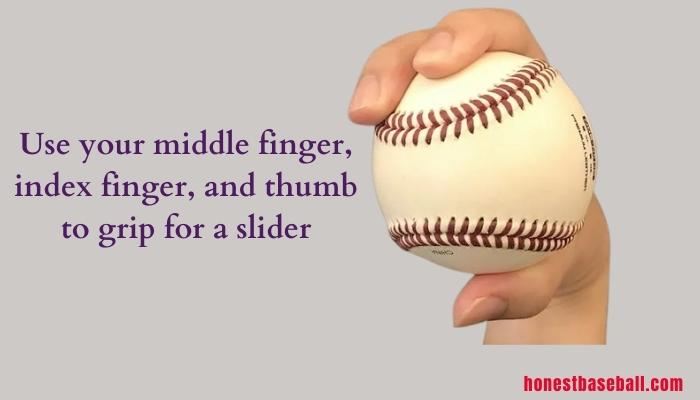
Also, the left-handers in my team used to use their middle fingers on the left half of the ball’s seam.
Place your thumb side on the ball exactly on the opposite side inside the seam, where you will use your index to twist the ball. Keep the thumb and other fingers closer. It will produce a perfect slider.
Think about the dial of an analog clock. put your index finger and middle fingers as they lay on the dial at 10 or 11 o’clock. And position your thumb side at the position of a clock where the dial of 4 and 5 sustain.
Now finally, two fingers are left. Put your ring finger and pinky finger outside of the ball away from the middle and index finger.
Turn your wrist slightly and release the ball. It will generate the necessary velocity for the ball.
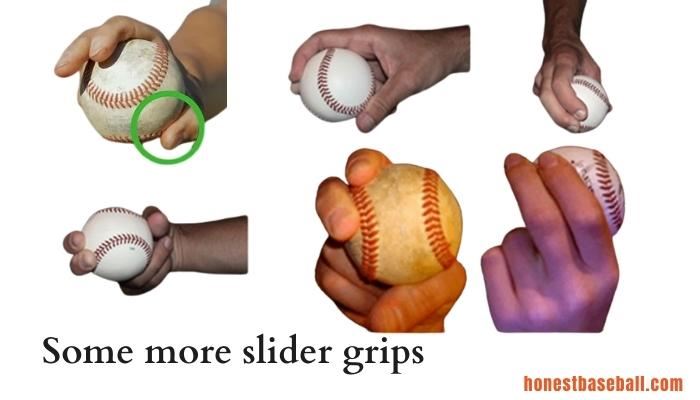
Also, make sure you produce the largest portion of pressure from the thumb. If you give to pressure from the other fingers, the ball will become a curveball.
Also, avoid twisting more so that your hands don’t get any injury. And last, try different grips for a good slider.
How To Throw A Slider?: The Techniques Of Throwing Arm Sliders

Learning sliding mechanics and developing them is the first thing for pitching sliders. To master the nasty slider, you must follow some precise techniques.
So, make sure you have developed some effective techniques before you throw sliders.
The Arm Motion While Preparing To Release The Slider
Before releasing the ball, think about the speed of the ball. Remember, though you are going to throw a slider, the speed is a must. So, make sure you are going to pitch with a fastball speed.
Don’t twist your wrist. Rather keep your wrist loose before releasing the ball. Make sure your index finger is on the top of the baseball.
Maintain a parallel relationship between your hand and elbow. Demonstrate your arm path like you’re throwing a fastball.
Keep your body steady, make your throwing arm as fast as fastball pitching, and shorten the arm path so that the elbow doesn’t get any pain.
The Arm Motion While Throwing A Slider
While releasing the ball, slightly tilt your wrist to a quarter turn. Make sure your ball has a tight spin on it. In order to accomplish so, you must put your first finger on the top of the ball.
Also, you should flex forward your wrist when you want to ensure a good slider. If you feel a burning sensation on your first finger, you can be assured that the ball has been cut down properly.
Foot Forward Motion
To learn the breaking ball, you also need to work with your forward motion mechanism. You must control your motion along with the slider.
When throwing a slider, you must maintain your feet parallel to the ground. Transversely cross your throwing hand from one side to the other of your body.
Also, you should apply pressure on the ball, to make the ball drop in front of the batter, so that he misses it. Come down off your wrist without the inward turn after releasing the ball as you pitched a fastball. The mechanics should be followed to develop the basic grip.
Alongside the slider, do you want to increase your pitching velocity? If so, you may check our guide on How To Increase Pitching Velocity By 10 MPH.
However, see some legendary slider grip thumb side spin in the following video.
The Steps Of Throwing A Slider Pitch: Your Index Finger Impacts
After learning the basic things about slider grip, ball spinning, and other key points of good slider grips, now is time to throw a slider.
So, how to throw a slider perfectly? You have got to go here.
Have The Perfect Grip With Index And Middle Fingers
Make sure you perfectly grip the ball. Put your index finger and middle finger on the ball. Put them as if you are going to pitch a two-seam fastball.
Make a fist with your index and middle fingers and place them on the ball. It is preferable to keep your grip on the ball slightly off-center.
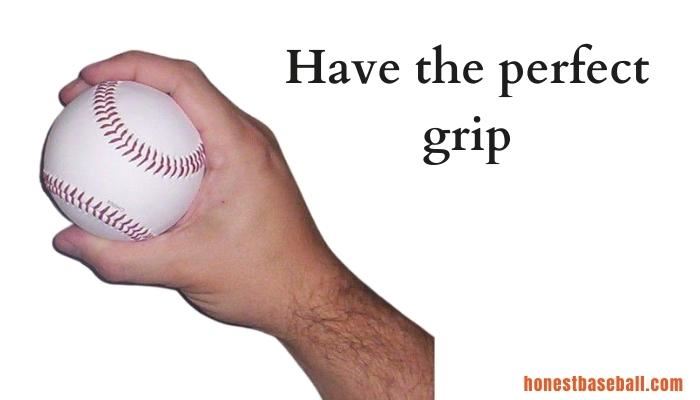
Generate pressure on the ball from your index finger. Make sure the pressure comes from the thumb side to the index finger.
Now, keep the ball tight. You need to throw a slider now.
Make Sure You Hide Your Grip From The Batter
Either right-hander or left-handed batter, whoever is on the home plate, hide your grip from him. It is necessary so that he cannot read the action of your hand.
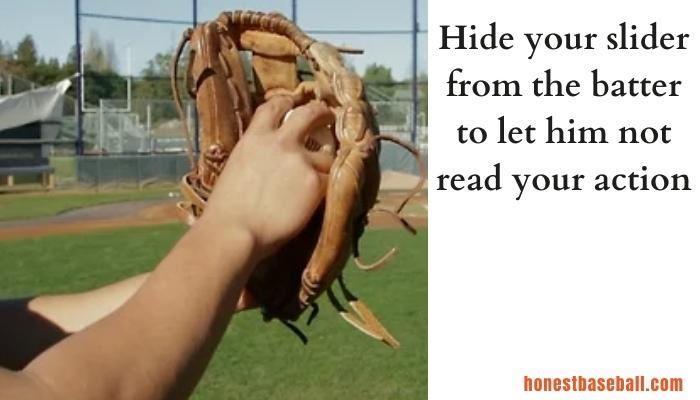
The advice is strongly preferred for the youth pitchers.
Wind Up Your Body And Throw
Shift your body weight from back to front. aim to the home plate, and follow the motion of your body.
Maintain a parallel stride with your foot and ensure that your throwing hand crosses the front of your body.
Keep Your Wrist Loose During Release The Ball
Don’t tighten up your wrist while releasing the slider. Though using the index and middle fingers, apply a little pressure on the ball with your index finger so that the ball gets a late break.
Just keep your wrist from twisting.
Snap The Wrist Of Throwing Hand While Releasing The Pitch
Snap your wrist upside down to the opposite leg side of the hand. Be sure that the snapping is not the same as the twisting.
Make Understand Yourself As If You Are Throwing A Fastball
Keep your wrist at such an angle that you are pitching a fastball. Just have a slight spin of the index finger for the late break of the ball. If you can create large angles with your finger, it will create wider breaking balls.

The success of the slider depends on its breaking time. The last-minute break brings the most successful result of a slider.
Make the proper use of your wrist, thumb, index, and middle fingers. The pro pitcher’s updated apr also follows these rules.
Be Assured With The Following Consideration
Make sure you consider the following key point for throwing a slider.
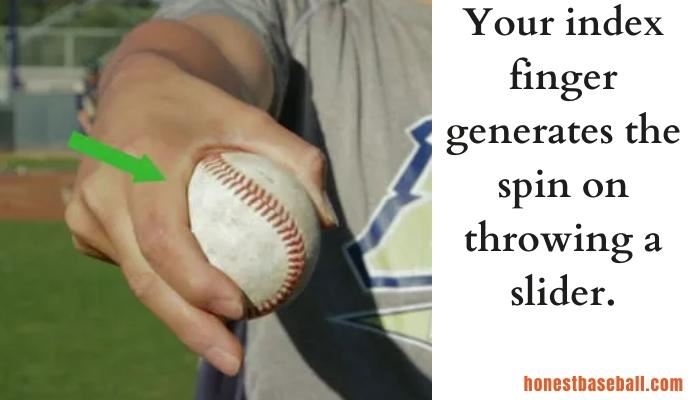
- The most basic one is, if you throw to a right-handed batter, make sure you throw the ball outside part of the home plate. Do the vice versa for the left-handed batter.
- Target the corner of the strike zone. This increases the chance that the batter misses the ball.
- Your index finger generates the ball spinning. So, don’t let the other parts of your hand do something here.
Do you want to the difference between a slider and a curveball? Then you should read this article to find the difference between a slider and a curveball.
Facts To Keep In Mind While Learning The Sliders
In my workout programs, I always give some advice to my students who want to learn sliders (actually for all types of pitches). This advice is also for you if you are among the youth pitchers. Keep this advice while learning the slider.

- Start the pitching with less speed. Don’t be in a hurry and increase the speed from the fast. A slow start will help you to get a better result.
- After some workout programs, start to add speed to the slider.
- Follow the rules for developing your mechanics. Keep patience.
- The last thing,
You need practice and practice. Throw the sliders “THOUSANDS OF TIMES”. Don’t lose your patience. Believe me, it takes time to become a good pitcher with an effective slider.
Big league pitchers spend a lot of time developing their performance.
Slider is one of the most important pitches in baseball? Along with sliders, there are many pitches used in the game. The guide on “What Are The Best Pitches To Throw In Baseball?” would be knowledgeable for a youth pitcher.
Some Common Misconceptions About Sliders
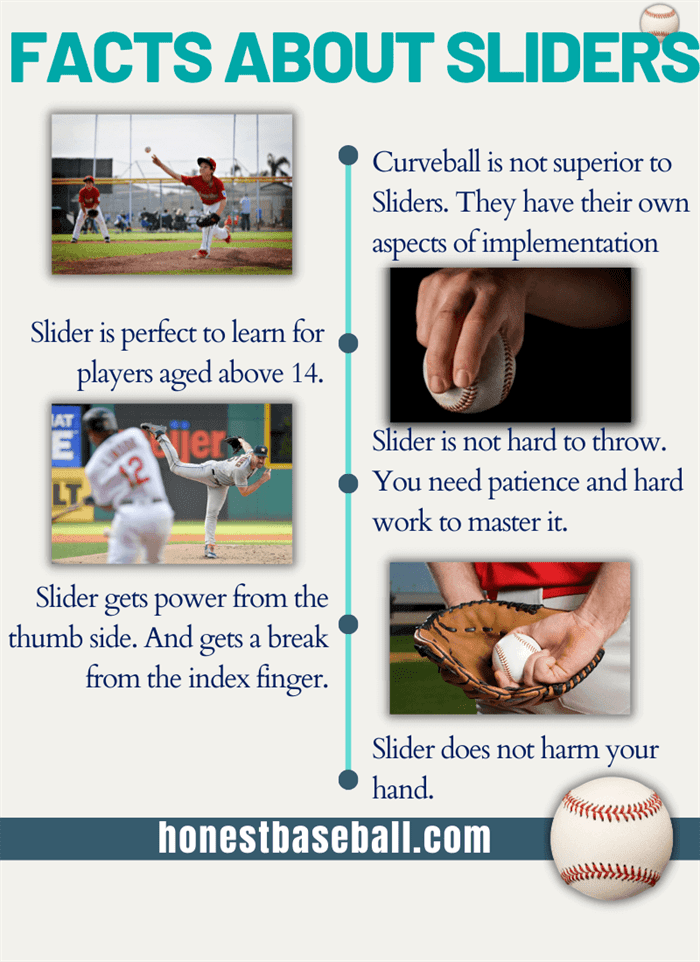
- Many people think that the sliders are not fit for youth players. But this is not true. But, if a kid can learn a curveball, he also can learn the sliders. But, learning any breaking ball is perfect for the players above the age of 14.
- Many think the slider is hard to throw. But the truth is, it is easier than the curveball. But, during the learning period, any kid can throw a poor slider or a poor curveball. But, most collegiate players throw sliders as their first choice, because it is easy to throw.
- Many also think that the curveball is better than a slider. But, how could you say that? They are two different types of pitches. Both of them have their different aspects. Like you are comparing an apple to a watermelon that serves two different perspectives.
In the ultimate point, it’s you who will decide the perfect choice for yourself. The pitches are not that important. The important thing is, how masterfully you can throw one of them to get the best results.
However, there is no way to skip practicing more and more to develop your pitching skills. But, you will not get any mate to help you practice pitching. So, knowing how to practice pitching alone would be an effective solution for this.
Here is another article on How to play catcher in Baseball. I think it will help you to improve your tactical skills if you want to be a catcher in the future.
The Growth Plate Truth: When Should Your Kid Throw a Slider?
If you ask ten different coaches when a kid should start throwing a slider, you’ll get ten different answers. Let’s look at the Honest Truth about growth plates and arm health.
Despite the myths, the mechanics of a slider aren’t inherently more dangerous than a fastball. The danger comes from overuse and poor arm action. When a young pitcher tries to “force” a break they aren’t physically ready for, they compensate by dropping their elbow or “yanking” their shoulder. That’s when growth plate injuries happen.
The Honest Timeline:
- Age 10-12 (The “Feel” Phase): It is okay to learn the grip. Let them throw it at 50% effort during catch play to see how the ball moves. No competitive sliders in games yet.
- Age 13 (The Transition): Start incorporating the “Preset Mechanic” in bullpen sessions. Focus 100% on spin and 0% on “nasty” break.
- Age 14+ (The Green Light): Once a player hits puberty and their core strength increases, they can begin throwing “full-effort” sliders in games.
The Bottom Line: Don’t let a 12-year-old chase strikeouts with a slider. Build the arm strength with fastballs and changeups first; the “wipeout” slider will be there when their body is ready for it.
Frequently Asked Questions
Do Sliders Harm Your Hands?
Actually, if you are an athlete, there are chances to face injuries in many ways. This is a different fact. But fundamentally, the sliders will not harm your hand if you throw a slider correctly.
How Do You Throw A Nasty Slider?
Grip the ball like a two-seam fastball. Keep the ball slightly off-center. Generate the manipulation with the combination of the index and thumb sides.
Release the ball with a one-finger impact (index). If you want to use two fingers, it will end up as an imbalanced pitch.
When Should You Start Throwing A Slider?
Basically, a slider suits a player when he turns into 14 or more. To be honest, before 14, you shouldn’t let your kids try a slider or curveball.
However, to entirely learn sliders will take them 1 to 3 years.
Now you know hot throe a slider. So, you must be excited to learn what is a cutter pitch?
Conclusion
Slider is one of the most crucial pitches for a pitcher. Masterly crafting a slider will help you bluff the batters and get them out easily.
So, learning how to throw a slider is essential if you want velocity with curving the ball. But, there is no alternative to going under the supervision of a coach at all.
By the way, what do you think about sliders? Have I missed something? Or is there anything that could be added to master a slider more easily?
Why are you waiting? Ping me in the comment box.
Hello everyone. My name is Jason Butler, and I live in California, America. I was a professional AAA Minor League Baseball player. I lost my chance of playing MLB for injury issues, but I did not lose my love for baseball. I attended the coaching training program and am now working as a coach in a small school in San Diego.
I always love to share my experience and knowledge if that can help you. Play baseball, and stay fit.