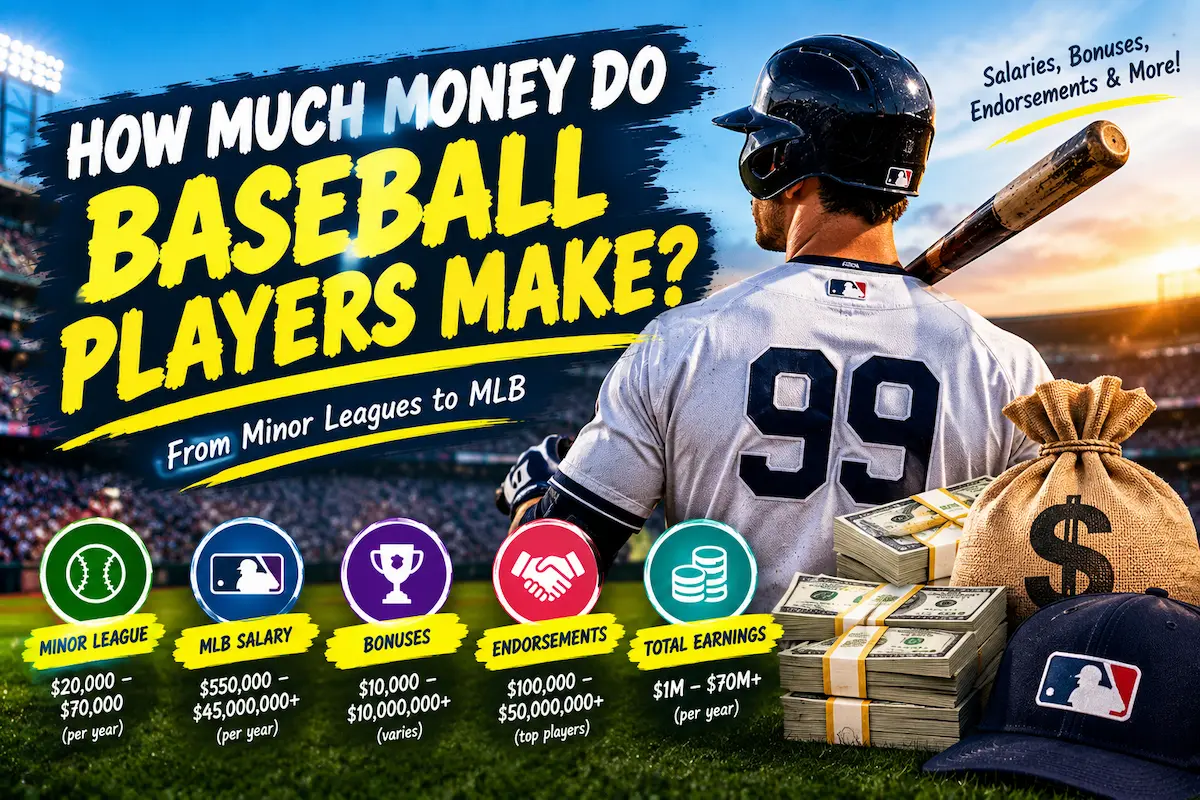
Baseball is more than simply a hobby because it is a multibillion-dollar enterprise around the world.
Baseball players’ pay is among the highest in professional sports, helping to establish baseball as a byword for affluence.
Baseball is flush with cash because of multi-million dollar contracts and enormous sponsorship deals.
Maybe you’re curious about how much annual salary baseball players make. That is exactly what I am going to cover today.
So get your peanuts and Cracker Jacks, because I am going to talk about the money side of America’s favorite sport.
⚾ Coach Jason’s “Real Take-Home” Calculator
Enter an MLB salary to see how much the player actually keeps after taxes, agent fees, and club dues!
Average Salary of a Major League Baseball Player
💰 How Much Do MLB Players Make in 2026?
Thanks to the current Collective Bargaining Agreement (CBA), Major League Baseball players are making more money than ever before. Unlike the NFL, MLB contracts are 100% fully guaranteed. Here is the financial reality for a big leaguer in 2026:
| Salary Category | 2026 Figure | Who Earns This? |
|---|---|---|
| The League Minimum | $780,000 | Rookies and players with less than 3 years of MLB service time. |
| The MLB Average | ~$5.2 Million | Veterans who have hit salary arbitration or free agency. |
| The Superstars | $35M – $50M+ | Elite franchise players (e.g., Aaron Judge, Shohei Ohtani, Juan Soto). |
When you see a headline saying a player signed a “$700 Million Contract” (like Shohei Ohtani), they are not getting a $70 million check this year. Teams use contract deferrals to avoid luxury taxes. Ohtani actually only takes home $2 million per year in base salary right now, with the remaining $68 million per year deferred until his contract expires! Do not always believe the massive headline numbers.
Bonuses and Other Earnings for MLB Players
Aside from their base salaries, MLB players can also earn bonuses and other forms of compensation.
Performance-based awards like All-Star selection, Gold Gloves, Silver Sluggers, and Cy Youngs are common examples of such motivations.
In addition to individual accolades, many teams offer incentive clauses tied to team success. For example, a player might receive a bonus if his team makes it to the playoffs or wins the World Series.
Some players may also negotiate signing bonuses when they sign contracts with new teams.
For instance, a Cuban infield prospect Yoán Moncada got a record signing bonus of $31,500,000 in 2015. (Source: Baseball Almanac Baseball Signing Bonus Research)
These are one-time payments meant to compensate for leaving their previous club or entice them into signing with a particular organization.
Endorsement deals are another way that baseball players can supplement their income. Top-performing athletes often land lucrative sponsorship agreements with companies who want to use their image and popularity to sell products.
These additional earnings can make a significant difference in an athlete’s overall compensation package.
However, they’re not guaranteed and rely heavily on individual performance and market demand.
Minor League Salaries Compared to Major League Salaries
For decades, minor leaguers were paid starvation wages. However, after finally unionizing, a historic CBA was signed that vastly improved their living conditions. They are now paid nearly year-round, and teams are required to provide them with free housing.
~$27,300 / year
~$30,250 / year
~$35,800+ / year
Differences Between Player Salaries in Different Leagues
At $4 million annually, Major League Baseball (MLB) pays its players more than any other professional baseball league. In comparison, the average salary in the Nippon Professional Baseball (NPB) and the Korea Baseball Organization (KBO) is significantly lower.
Salary disparities between leagues can be attributed, in part, to variations in competition.
Players in Major League Baseball are commonly recognized as the finest in the world, therefore they naturally command larger compensation than those in less competitive leagues.
The amount of money a team has coming in can also have an impact on how much they’re willing to pay their players. Teams in larger markets, where there are more fans and corporate sponsors, bring in more money for MLB than those in smaller markets.
Benefits and Bonuses for Other Baseball Players
Professional baseball players, especially those who play in Major League Baseball (MLB), earn some of the highest salaries of any athlete in the world.
While their salaries are certainly impressive, there are other benefits and bonuses that these players receive as well.
One common benefit for MLB players is access to top-of-the-line medical care. With grueling schedules and physical demands, injuries can be commonplace for baseball players.
However, clubs spend a lot of money on medical personnel and facilities to provide the finest treatment for their athletes.
Another notable benefit is travel accommodations. MLB teams travel extensively throughout the season, often playing games across the country or even internationally.
To make this process as smooth as possible for their athletes, teams typically provide first-class travel arrangements such as private jets or luxury buses.
In addition to benefits like medical care and travel accommodations, many baseball contracts also include bonus structures based on player performance. For example, a pitcher may earn a bonus if they reach a certain number of strikeouts in a given season or if they win a particular award.
Being an MLB player comes with many perks beyond just salary alone. From exceptional healthcare to luxurious travel arrangements and performance-based bonuses – it’s clear why so many people aspire to play at this level!
Factors That Impact Player Salaries
The salaries of baseball players are not just determined by their skills and performance alone. Several factors impact player salaries, including:
1. Market demand: The market value of a player is heavily influenced by the demand for their services from teams and fans.
2. Contract length: The length of a player’s contract can significantly impact their salary as it determines how long they will be with the team.
3. Age: Younger players typically make less money compared to older, more experienced players who have established themselves in the league.
4. Performance incentives: Players can earn additional bonuses based on their performance on the field such as winning awards or making it to playoffs.
5. Negotiation skills: A player’s agent plays an important role in negotiating higher salaries for them.
6. Team budget constraints: Teams have limited budgets which can affect how much they can offer to individual players, especially when signing new contracts or free agents.
Many factors contribute to determining a baseball player’s salary, some within their control while others outside of it. Understanding these factors is crucial for both players and teams during contract negotiations and for building successful rosters over time.
How Do Player Salaries Vary by Position?

Player salaries in baseball can vary greatly depending on the position they play. Generally, pitchers tend to earn the highest salaries compared to other positions.
This is because pitchers are considered to be the most valuable players on a team and have a significant impact on winning games.
Starting pitchers typically earn more than relief pitchers due to their larger workload and a higher level of skill required. The top starting pitchers can command salaries upwards of $30 million per year.
On the other hand, catchers tend to have lower average salaries compared to other positions despite being an important defensive player. This is because catchers often have shorter playing careers due to the physical demands of the position.
Infielders and outfielders generally fall somewhere in between starting pitchers and catchers in terms of salary range. However, star players in these positions can also command high salaries if they perform well consistently over time.
While there may be variations in player salaries by position, it’s worth noting that factors such as experience, performance, market demand, and overall value also play a crucial role in determining a player’s earnings in baseball.
Comparison of MLB to Other Sports Leagues
When it comes to professional sports, salaries are always a hot topic. Comparing the salaries of Major League Baseball (MLB) players to those in other sports leagues can be tricky since each sport has its own set of factors that impact player earnings.
One key difference between MLB and other sports leagues is the length of their respective seasons. MLB players have a 162-game season, which is much longer than most other major North American sports leagues.
This means they have more opportunities to earn money through game contracts and endorsements.
Another factor that sets MLB apart from other leagues is its revenue sharing system. Unlike some other leagues where teams keep all revenue earned from games and merchandise sales, MLB shares revenue among all teams in an effort to level the playing field for smaller market teams.
Baseball may not have as many high-profile stars as boxing or golf, but it still has plenty of well-known individuals who command top dollar for their talent on and off the pitch.
There are pros and cons unique to each sport that make direct comparisons difficult. However, it’s safe to say that baseball remains one of the highest-paying professional sports out there today.
For a better understanding, you can see the below table comparing MLB to other major sports in the USA.
| League | Yearly Salary Range (Average) | Yearly Salary Range (Top Players) |
| MLB | $1 million – $30 million+ | $40 million+ |
| NFL | $500,000 – $3 million+ | $20 million+ |
| NBA | $1 million – $40 million+ | $40 million+ |
| NHL | $500,000 – $10 million+ | $10 million+ |
Historical Context of Baseball Salaries

The history of baseball player salaries dates back to the early 1860s when players received only a small amount of compensation for their services. During this period, baseball was considered more an amateur sport rather than a professional one.
But in the late 1800s and early 1900s, various leagues began to organize, and professional baseball took shape. As such, players started receiving better pay compared to earlier times. But it wasn’t until after World War II that player salaries really took off.
There were a number of variables that led to a rise in player pay in the late 1940s and early 1950s. For instance, there was a rise in the popularity of televised games which brought in more revenue. Additionally, Major League Baseball (MLB) also saw increased attendance due to post-war prosperity.
Moreover, free agency became part of MLB’s collective bargaining agreement from the mid-1970s onwards, further boosting salaries across all positions.
Today’s modern era is marked by huge contracts worth millions or even billions of dollars for star players who have proven their worth on and off the field alike.
However, despite these massive sums being paid out today – some argue that there are still salary disparities between different positions and ethnicities within baseball which need addressing moving forward into future seasons
The Highest-Paid Baseball Players
Baseball salaries have exploded in recent years. While the average MLB player makes around $5.2 million in 2026, the game’s elite superstars are signing record-shattering contracts that dwarf the rest of the league. When evaluating the highest-paid players, the most accurate metric is AAV (Average Annual Value).
⚾ The Highest-Paid MLB Players in 2026
1. Shohei Ohtani (Los Angeles Dodgers)
$70,000,000 AAVThe Contract: 10 Years / $700 Million
Coach’s Breakdown: Ohtani broke every record in North American sports history with this deal. However, the contract is heavily deferred. Ohtani only takes home $2 million a year in base salary right now, with the remaining $68 million per year deferred until after the contract ends. Still, his nominal AAV makes him the undisputed king of baseball wealth.
2. Zack Wheeler (Philadelphia Phillies)
$42,000,000 AAVThe Contract: 3 Years / $126 Million (Extension)
Coach’s Breakdown: Zack Wheeler earned every penny of this massive extension that kicked in for the 2025-2027 seasons. Unlike Ohtani’s deal, Wheeler’s contract has zero deferrals. He has been one of the most dominant and durable starting pitchers in the National League, and the Phillies paid top dollar to keep their ace.
3. Aaron Judge (New York Yankees)
$40,000,000 AAVThe Contract: 9 Years / $360 Million
Coach’s Breakdown: After breaking the AL single-season home run record, the Yankee Captain secured the largest free-agent deal ever given to a position player at the time. Earning a flat $40 million per year through his late 30s, Judge is the true face of the Bronx Bombers.
4. Jacob deGrom (Texas Rangers)
$37,000,000 AAVThe Contract: 5 Years / $185 Million
Coach’s Breakdown: When healthy, deGrom is arguably the most unhittable pitcher of his generation. The Rangers took a massive gamble on his health by offering this monster AAV, proving that elite pitching commands the ultimate premium in modern baseball.
5. Mike Trout (Los Angeles Angels)
$35,541,667 AAVThe Contract: 12 Years / $426.5 Million
Coach’s Breakdown: Trout’s 2019 extension set the standard for mega-deals. While his AAV has dropped slightly out of the top three in recent years, his total contract value of $426.5 million remains one of the largest financial commitments to a single player in sports history.
Salary Disparities in Baseball
Most players don’t make nearly as much as the highest-paid athletes, who might earn millions of dollars in a single season. Some people have claimed that this inequality proves the system is unfair.
Playing expertise and positions also impact the salary of a baseball player.
For instance, pitchers and home run hitters typically receive more paychecks than players who play other positions, such as second basemen and catchers.
A level of expertise is also important. It’s possible that rookies make far less than seasoned pros. Furthermore, minor league players are often just as good as their major league counterparts, but they make a fraction of the salary.
It’s important to remember, though, that baseball players’ paychecks aren’t determined just by how well they play. The amount of money a player may make through endorsements and sponsorships is directly related to how well-known and marketable he is.
Although pay inequality may appear unfair at times, it is an unavoidable fact of business. Baseball player salaries are heavily influenced by market forces similar to those in any other industry.
Wrapping Up
Baseball players earn a lot of money, but their salaries are influenced by various factors. The average MLB player’s salary is impressive, and the highest-paid players take home millions of dollars each year. But there is a big difference between the most and least-paid players in baseball.
Moreover, while major league players enjoy high salaries and many benefits like bonuses, pension plans, and health insurance for themselves as well as their families; minor league players often struggle financially with low pay rates.
It’s also interesting to note that player salaries vary greatly based on the position played within the team. Pitchers tend to earn more than position players because they have a bigger impact on a game’s outcome.
Although baseball is often regarded as America’s favorite sport, being a professional player requires more than just on-field success; financial stability is also crucial.
More Resource
How Much Does A Baseball Coach Make In A Year
How Much Do Baseball Scouts Make
How Much Do MLB Cheerleaders Make?
Do MLB Umpires Pay For Travel?

Hello everyone. My name is Jason Butler, and I live in California, America. I was a professional AAA Minor League Baseball player. I lost my chance of playing MLB for injury issues, but I did not lose my love for baseball. I attended the coaching training program and am now working as a coach in a small school in San Diego.
I always love to share my experience and knowledge if that can help you. Play baseball, and stay fit.