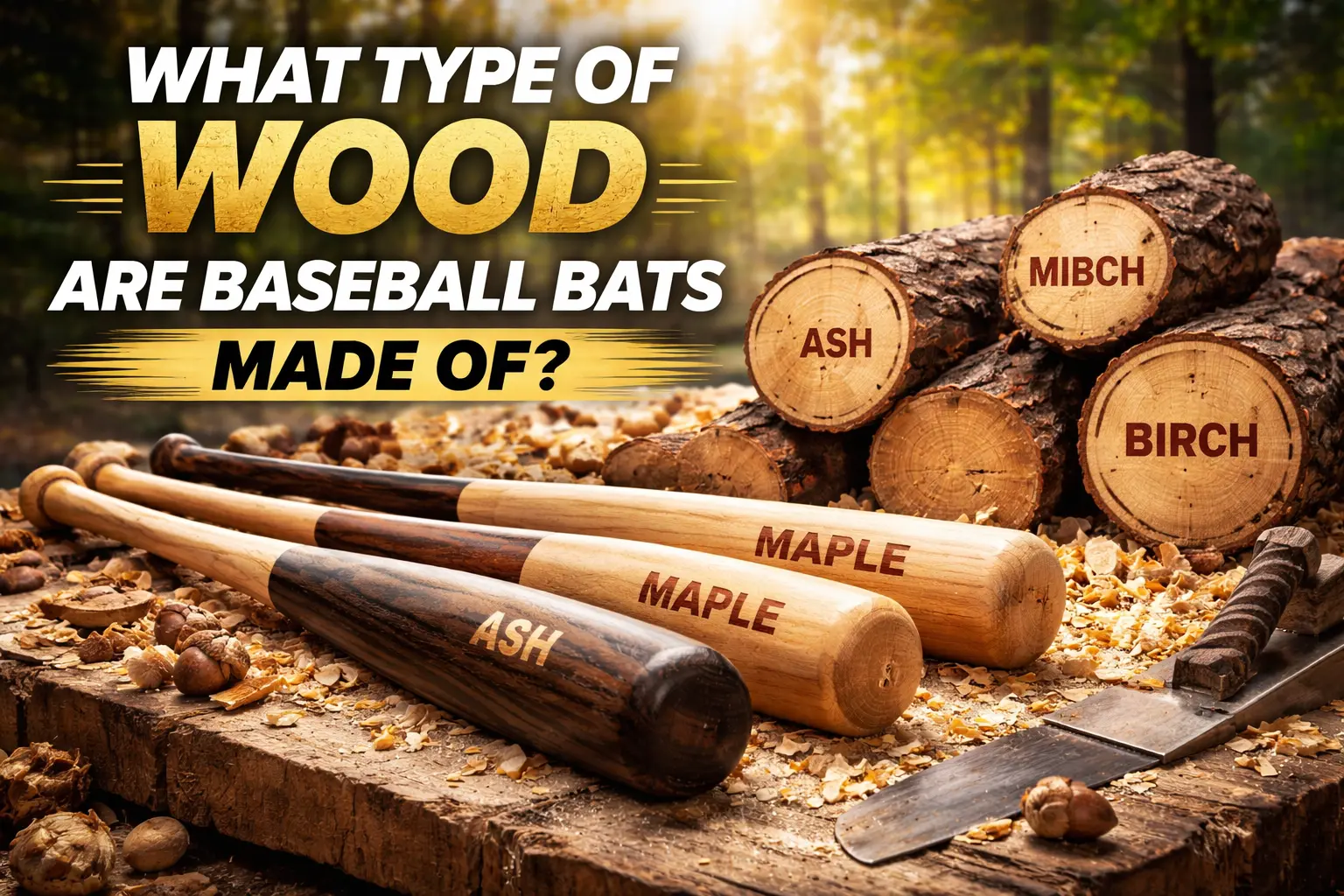
Baseball bats are made of various types of materials. Wood and wood composite baseball bats are one of the most popular materials. Today even kids practice and play games with wooden baseball bats, but what type of wood are baseball bats made of?
Not all types of wood are used for baseball bat production. There are only a few types of wood used in baseball bats. Every type of wood has its specific benefits and of course player type suitability. In other words, adults can’t play with the bat for kids as they are made with specific benefits and personal preferences.
You may think that knowing the types of wood used in baseball bats is not that necessary. But think your kid is in practice or in a live game with a wooden bat and suddenly there’s an unusual sound on that bat? What will you do then?
In this article, I’ll discuss with you what type of wood are baseball bats made of and their objectives. Stay tuned.
The History
Back in 1800, there was no standard rule for baseball bat making. Players used to make their bats mostly from wagon tongues. Most of them were Hickory wood made and weighed around 50 ounces.
From 1884 players started to realize that they needed some helping hand. And woodworkers were the first choice because of their expertise. During this period several changes were noticed, including wood types, design, etc.
Various types of experiments have been done since then. And in this way, the concept of today’s standard rules was born. Here you’ll find the Official Baseball Rule, Major Baseball League.
If you find it complex, I have another article on official rules, I hope you’ll find it helpful.
What Type Of Wood Are Baseball Bats Made Of : The Autopsy
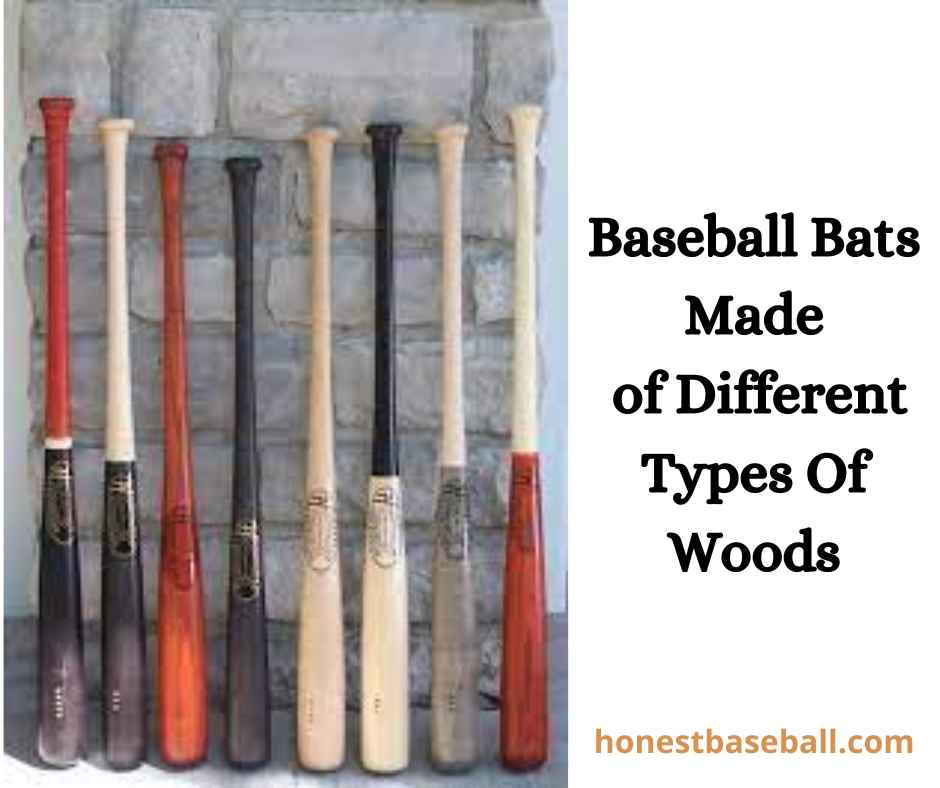
If you have made it up so far, then hope you can remember the type of wood used in baseball bats. 3 types of wood are mostly used in baseball bat making; they are Maple, Ash, and Birch. Though there are some other wood types and composites too used in baseball bats.
The Grading
Sports kit manufacturing companies make millions of products but only a fraction of that quantity appears in tournaments or leagues. The same goes for Baseball bats too. But what about the grading?
Normally in Major baseball leagues, the hitters choose very few bats for live games and the rest for practice. At the end of the league, these bats are passed through minor leaguers, college leaguers, and so on.
Normally the shipment of baseball bats arrives in dozens. You may find a few bats with clunks among the dozens at the local store. Hence it’s important to know the factors to look at in the baseball bat before buying.
To date, ash wood is widely used for baseball bat making. And choosing a bat made of ash wood is a lot easier. It has porous wood cells in a ring shape. And in ash wood, you can find those rings of grains on blind eyes.
Grains’ parallel position to the center makes the baseball bat structure strongest. On the other hand, the more the grains move from the center line the weaker the baseball bat gets.
Again, you/hitters must look for the grain spacing. The wider space between the grains means more strength. These wide spaces mean the water and nutrients are full years of the tree’s life.
Moreover, these rings hold more water, which means more moisture within the wood. An ideal baseball bat for a major baseball league will have less than 10 rings. If your bat has more than 10 rings, change it sharp.
Body Parts Of Your Baseball Bat
Before diving into wood types, it helps to quickly understand the anatomy of your bat:
- The Knob: The flared bottom end that stops your hands from slipping off mid-swing; styles range from standard round to the modern ergonomic Axe shape.
- The Grip (Handle): The lower 18 inches where you hold the bat; a thinner handle feels lighter and faster, while a thicker handle offers better control for larger hands.
- The Taper: The transition zone where the thin handle gradually widens into the thick barrel. Note: This is the most common area where wooden bats break!
- The Barrel: The thickest hitting zone containing the “sweet spot” (usually a 2.5 to 3-inch section) where you want to make contact for maximum power transfer.
- The End (Cupped vs. Full): A “cupped end” has a hollowed-out tip to remove excess weight and improve balance, while a “full end” carries more mass for maximum swing momentum.
Type Of Woods
You can find different types of baseball bats in major leagues, small leagues, college leagues, and so on. You may have thought what type of wood are baseball bats made of, but have you ever wondered why there’s such variation? If yes, then stay tuned.
Below I’m going to describe all the types of wood used in baseball bats.
? Find Your Perfect Wood Bat
Answer 2 quick questions to match your hitting style with the right wood!
The Ash Wood
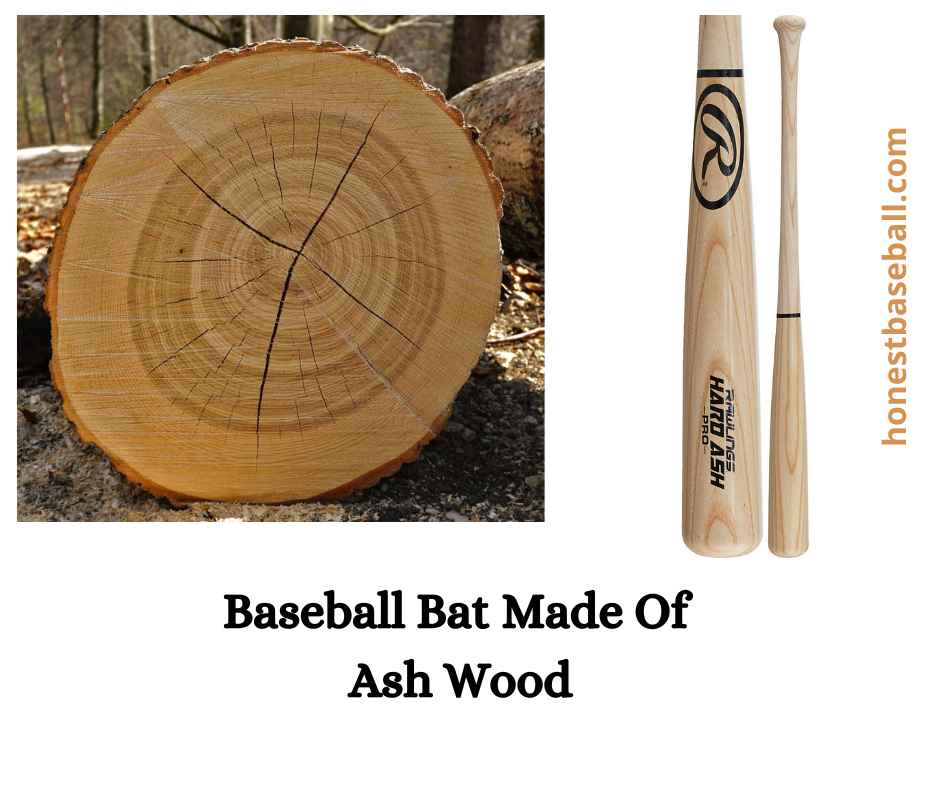
One of the most common types of the wooden bat is the Ashwood. You can call it the Northern white ash wood too. It is more popular because of its extra whip, in other words, flex like aluminum alloy bats.
While hitting, the grains of your bat must face the pitcher. You can do it easily this way, just take the label on, facing it straight up in the air or ground. This technique allows you to be in an optimal position to exit the ball speed and thus enhances the durability of the bat.
Pros
- You can count it as the least costly wood bat on the market.
- You can experience flex, like baseball bats with Aluminium-alloy.
- After breaking in, it stays together usually, which allows the bat to shard minimum while swinging.
Cons
- Wood grains tend to flake quite early. Which can end up with a barrel in bad shape, and unable to play.
- Comparatively less durable than the Maple and the Birch.
The Maple Wood
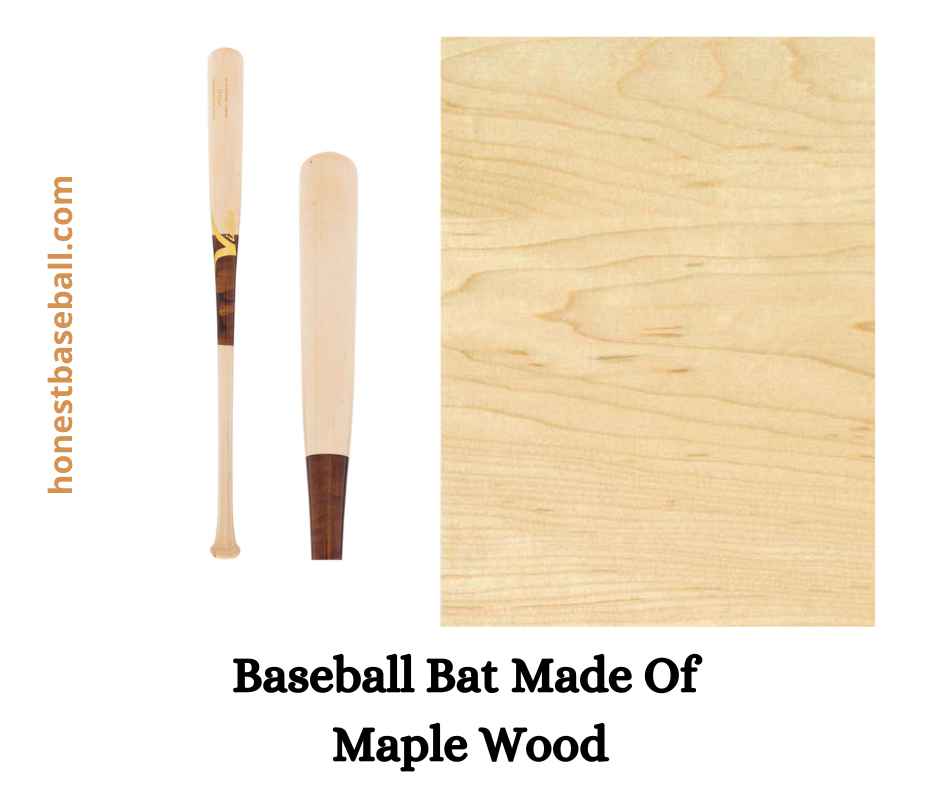
The maple wood-made baseball bats are much harder than you can hardly expect from others. You may not find the same type of flexibility as the Ashwoods. Albeit the Maple wood bats are harder but still it has a chance to break during the hit at the end part of the bat.
You may have heard about the maple bat shattering incident held in MLB. A study in 2008, shows that, when the pitch hits the top of the bat’s wood grains as opposed to wood grains, thus making the maple wood more durable.
It also prescribes that the wood types that don’t meet certain specifications mustn’t be purchased or played with.
Pros
- More hard and dense wood that allows the pitch to travel farther with a perfect hit.
- With a dense wood grain, you can experience the trophy shine in the bat.
- Very durable, as long as you break it.
Cons
- Comparatively more expensive than the Ash wood-made bats.
- It’s hard but there’s a chance that it can shatter easily and earlier than the Birch.
The MLB Ink Dot Test: Why It Matters for Maple Bats
If you ever inspect a pro-grade maple bat, you’ll notice a small, purposeful drop of black ink on the handle. As a coach, I get asked about this all the time by young players and parents.
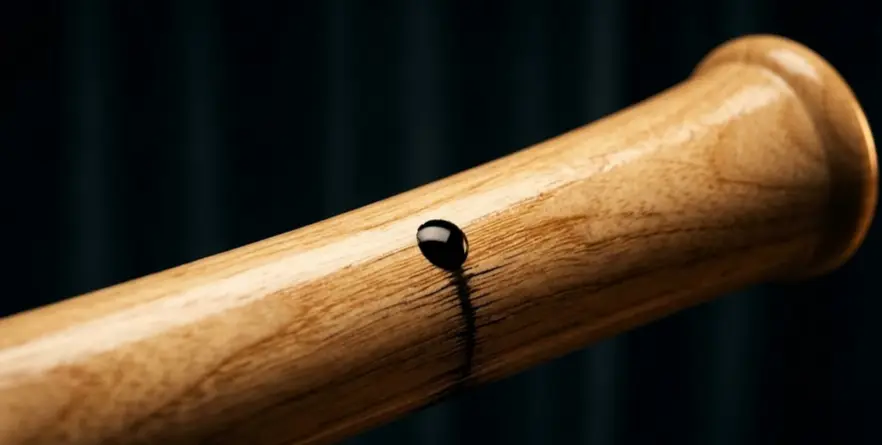
It isn’t a design flaw or a random brand mark—it is a strict safety requirement enforced by Major League Baseball.
Following a dangerous spike in shattered bats around 2008, the MLB mandated the Ink Dot Test. Unlike ash, maple has incredibly tight wood grains that are nearly invisible to the naked eye.
To ensure the wood is structurally sound, manufacturers place a single drop of ink on the face of the grain.
The ink naturally bleeds along the wood’s fibers. This allows inspectors to physically measure the straightness of the grain. According to MLB regulations, the grain angle must be exceptionally straight—with no more than a 3-degree variance.
If the ink bleeds at an angle greater than 3 degrees, the bat is instantly rejected for professional play because it carries a higher risk of snapping in half upon impact.
Coach’s Takeaway: When you buy a maple bat featuring an official ink dot, you aren’t just buying a piece of wood. You are holding a bat certified for maximum durability, structural integrity, and player safety. It is the exact same standard the pros use in the big leagues.
The Birchwood
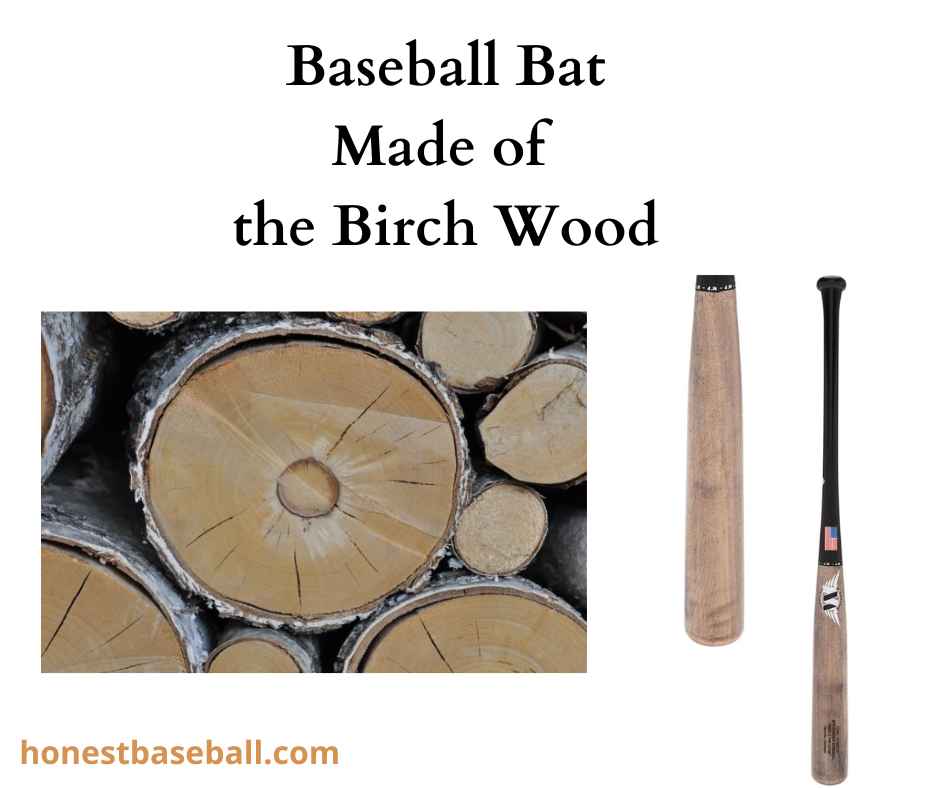
Baseball bats made of Birchwood are the best type that I have used in my career so far. You can find the benefits of both the Maple and Ash in this type of wood.
You may find some people whining about the break-in period of a fresh birchwood-made baseball bat. Just keep them apart and enjoy.
Pros
- You’ll find both flexibility and hardness in baseball bats made of Birchwood.
- Bigger life-span than baseball bats made of other materials.
- The combined facility of both Ash and Maple wood.
Cons
- It has little chance of a short break-in period. Can take around 30-50 hits to reach maximum hardness.
Again there are some other materials too, you can consider.
The Bamboo Wood
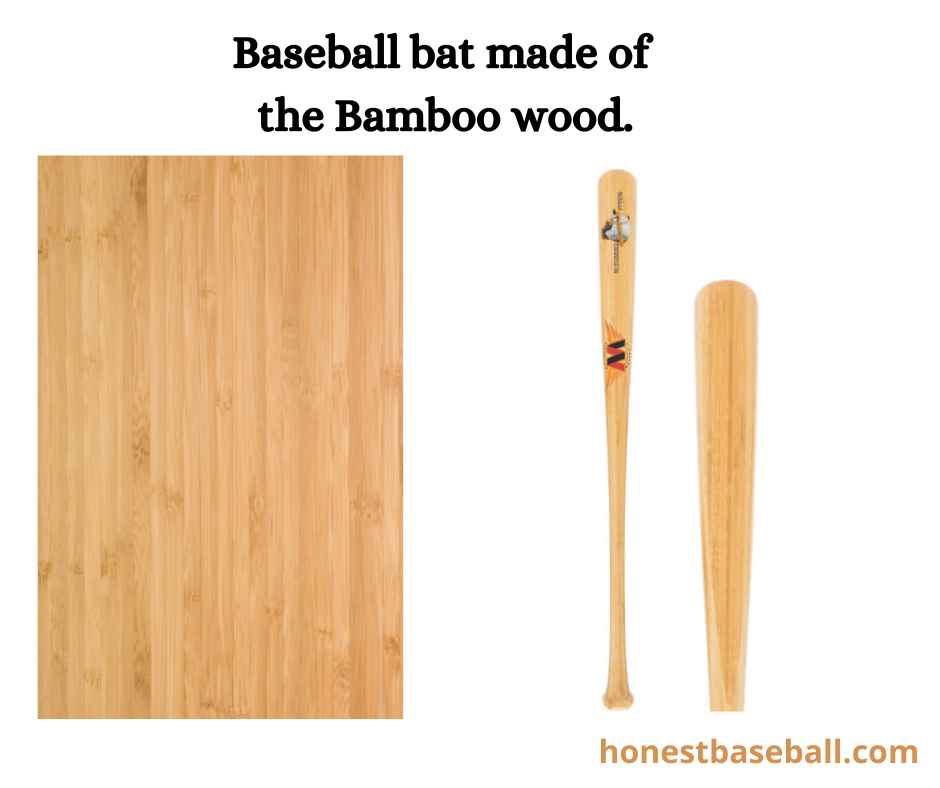
Bamboo is the longest species of grass on earth, we know it. It hasn’t been used for serious works like IE games. Baseball, Hockey, Golf, etc. But nowadays science has evolved such ways to use bamboo in place of wood. This allows to reduce the pressure from wood at a minimal rate so far and at the same time a more quality product.
Pros
- Very strong and durable so far.
- Very short break-in period.
- An eco-friendly solution compared to worldwide deforestation.
Cons
- MLB authority hasn’t approved it yet.
Composite Materials
Composite materials are the newest addition to the baseball industry. It has become quite popular in recent years. Composite baseball bats are made of two or more types of materials.
Normally piece (One or two pieces depending on bat type) of wood with a synthetic coating (polymer /artificial resin). Though this type of baseball bat is not allowed in professional baseball leagues. Leagues like Bundesliga tends to use this type of composite bat. You can count it as a good alternative to start without conventional wood bats.
Which type of wood is better?
In my baseball career, I have taken thousands of swings both in the practice session and in live games. Tried almost all the types of baseball bats and to be honest whatever brand/ company I choose, I enjoyed playing with that.
But among them, one thing was common which is the material type. Most of the time I used baseball bats made of Maple wood and sometimes Ash wood. Though baseball bats made from Birchwood are soft but have more life span than others.
Which Wood Matches Your Hitting Style?
Choosing the right wood isn’t just about picking the hardest bat; it’s about matching the material to your mechanics at the plate. A bat that feels perfect in my hands might feel terrible in yours.
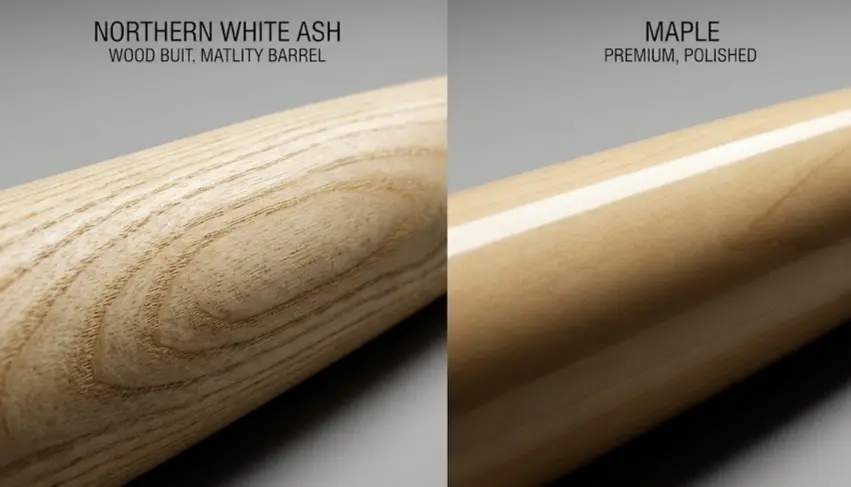
To make your decision easier, here is a quick breakdown based on hitting profiles:
1. For the Power Hitter (Choose Maple) If you are a strong, aggressive player who relies on bat speed and explosive power to drive the ball over the fence, maple is your ultimate weapon.
Its incredible stiffness and density mean that it won’t flex when it meets a 90 mph fastball. Instead, it transfers all your rotational energy directly into the baseball, generating massive exit velocities and longer home runs.
2. For the Contact & Gap Hitter (Choose Ash) Are you a leadoff hitter or a top-of-the-order guy who places the ball in the gaps? Do you rely on bat control and quick hands? If so, choose ash.
The natural flex (often called the “trampoline effect”) of an ash bat gives you the whip you need to drive hard line drives through the infield. It’s lighter, more forgiving, and offers exceptional control.
3. For the Transitioning Player (Choose Birch) Making the jump from BBCOR or aluminum bats to wood for the very first time? Birch is the perfect transitional wood.
It gives you the initial forgiveness and flex of an ash bat, preventing those painful hand-stings when you mishit the ball. However, after breaking it in (usually around 30-50 solid hits), the wood compresses and hardens up to feel as solid as maple. It truly offers the best of both worlds.
4. For the Cage Warrior & Practice (Choose Bamboo or Composite) If you spend hours in the batting cages hitting off high-velocity pitching machines, standard wood bats will eventually splinter or break.
For repetitive, heavy practice sessions, grab a bamboo or a wood composite bat. While they may not be legal for official MLB games, their near-unbreakable durability makes them the smartest financial investment for training.
I have another article on the 7 best wood bats in 2026 that may satisfy you.
I have tried Birch wood-made bats only in 1 or 2 games. In recent years I have tried the composite material made of baseball bats through my coaching sessions. And surprisingly they give you some new experiences that you can’t compare with others.
So the thing is, you have to focus on what you want and what will the bat provide you, that’s it. If you can deal this way then trust me, you’ll never repent for the baseball bat. I have another article in case you want to make your own baseball bat.
Frequently Asked Questions:
What wood bats do MLB players use?
3 types of wood bats are allowed by the M.L.B. authorities. They are Maple, Ash, and Birch. There Are some other materials too, like bamboo, metal alloy, and wood composite which are yet to be approved by the Officials.
What is the hardest wood for a bat?
Since the first baseball bat, back in 1800, baseball bats were made from Hickory wood. Baseball bats made with this wood are the hardest and heaviest ones compared to the present ones. Though these bats are restricted in MLB
What woods are Louisville Sluggers made from?
Louisville Slugger baseball bats mostly have two parts, half of those pro bats are made of Ash, and the rest is made of Maple wood.
What wood bat breaks easiest?
Baseball bats made from Ashes break very easily as it has a Trampoline Effect. Normally it just wears off. You can determine the usage time through the amount of grain on it.
How much does an MLB bat cost?
You can find a good MLB bat for $200. Normally the cost starts from around $59 and you may wonder about the quality, but that’s fine. And for that, I would recommend you to read some top-ranking MLB bat reviews. You can also consult with a former player or the coach.
Last Words
Since the first day, Baseball bats were made of a wood named Hickory, which used to be the heaviest and hardest bats to date. Since then the bat, batting style, shape, structure, material type, etc. almost all aspects have changed over time.
So far I have described all the types of wood with their pros and cons all from my experiences. So, instead of asking what type of wood are baseball bats made of, you can make your own choice. If you want more, you may follow my other articles below.
Feel free to comment with your suggestions, I’ll be glad to know and work on it further.
? Bat SelectorYou may also like:
How To Swing A Baseball Bat Correctly |Learn Easy Steps From A Coach
Positions On The Baseball Field Explained By A Coach
20 Best BBCOR Bats That Are Ready To Dominate The Plate In 2022
USA Vs USSSA Bats | Which One Is Right For You
Hello everyone. My name is Jason Butler, and I live in California, America. I was a professional AAA Minor League Baseball player. I lost my chance of playing MLB for injury issues, but I did not lose my love for baseball. I attended the coaching training program and am now working as a coach in a small school in San Diego.
I always love to share my experience and knowledge if that can help you. Play baseball, and stay fit.