
In 2026, the Eephus remains the ultimate insult in baseball. It is a delivery that effectively does “nothing,” yet it has the power to humble the world’s most elite hitters. While most pitchers are chasing triple-digit velocity, the Eephus Master is playing a different game entirely: a psychological war of patience.
Derived from the Hebrew word “Efes” (meaning zero), the Eephus isn’t a mistake or a “lofted” throw—it is a calculated disruption of the hitter’s internal clock.
The Honest Truth is that the Eephus shouldn’t work. Mathematically, a 50-mph ball is a “meatball.” But because it arrives on a 20-foot “rainbow” arc, it forces the batter to completely restart their brain mid-swing. It turns a professional athlete into a confused amateur in the span of three seconds.
Why It’s Back in 2026
With the rise of “Launch Angle” hitting, batters are trained to “track” fastballs on a specific horizontal plane. The Eephus breaks this plane vertically. By the time the ball reaches the plate, the hitter has usually lunged forward, lost their balance, and is left waving at a ball that hasn’t even arrived yet.
Coach Butler’s “Honest” Insight: “Throwing an Eephus takes more ‘guts’ than throwing a 100-mph heater. You are essentially daring the hitter to hit it. But when you pull the string and watch a $30-million-dollar player swing and miss at a 45-mph ‘nothing’ ball, you realize it’s the most efficient out in the game.”
The Physics of “The Hump”: Breaking the Hitter’s Eye Level
Most coaching guides will tell you the Eephus works because it’s slow. That’s only half the story. In 2026, with advanced ocular tracking data, we know the real secret isn’t just low velocity—it’s Eye-Level Disruption.
When a standard fastball or slider is thrown, the hitter’s eyes track the ball on a relatively horizontal plane. Their brain calculates the “tunnel” and the “point of contact” based on that linear path. But the Eephus creates what we call “The Hump.”
Vertical Tracking vs. Horizontal Plane
When a ball arcs 15–20 feet into the air, the hitter is forced to move their eyes (and often their entire head) vertically to keep the ball in sight.
- The Disruption: This vertical shift breaks the hitter’s ability to stay “on-plane.” By the time the eyes move from the peak of the arc back down to the hitting zone, the brain has to “re-calibrate” the distance and speed from scratch.
- The “Lawn Chair” Effect: This is why you see professional hitters “buckle” or collapse their backside. Their brain tells them the ball is coming, but their body is out of sync because the visual data was interrupted by that massive vertical hump.
The Honest Truth: > “The Eephus isn’t hard to hit because of its movement; it’s hard to hit because it forces the batter to restart their brain mid-swing. It’s not a physical battle; it’s a timing heist.”
What Is an Eephus Pitch?

Unlike traditional baseball pitch, an Eephus pitch is the slowest pitch thrown by a pitcher. It is a kind of trick pitch that bluff the hitter off guard. You will see that the Eephus pitches are thrown overhand like traditional pitches. But, the low velocity and high traveling path make the pitcher super slow pitch.
You may also hear the phrases like overhand softball pitch, slow pitch softball, blooper ball, balloon ball, rainbow pitch, LaLob, bugs bunny curve, etc., which are used to call the Eephus pitches.
The Eephus is known as slow pitch delivery because it is thrown at a significantly lower speed. Whereas the normal baseball pitches are thrown I’m between 70 to 100 mph, most pitches of Eephus are thrown as lower as 35 to 55 mph.
Though the name Rip Sewell is attached to the invention of the slow-motion pitch, historians John thorn and John Holway name Bill Philips as the first pitcher who pitched the Eephus pitch.
Bill Phillips played baseball from 1890 to 1903 in the National League. On the other hand, Rip Sewell resurrected the slow pitch after around 40 years of Bill Phillips.
Does MLB Allow Eephus Pitch?
Yes, the answer is positive. MLB allows and legalizes the Eephus pitches in games. But, if the pitcher tries to deceive the batters with deceiving arm and pitch rotation, it’s not legal and allowed.
also, a pitcher can reduce the pitching speed as much as he wants, as there is no restriction on it.
Do you know about foul balls in baseball? An detailed explanation would help you to learn more about this. You may follow our guide on “What Is Foul Ball in Baseball? An Unforgivable Violation!” for detailed discussion.
The History of the Slow Pitch/Eephus Pitch
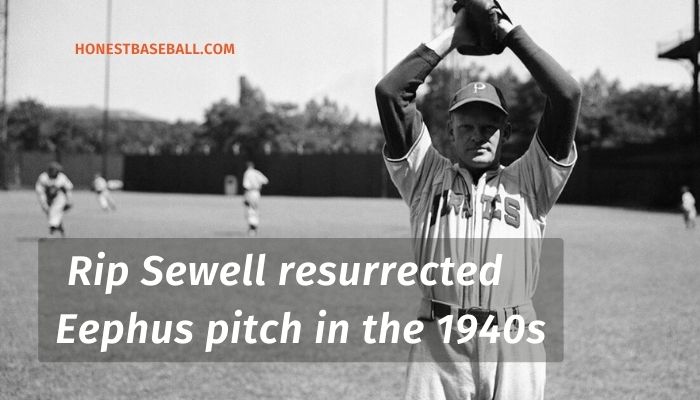
The Eephus pitch is first thrown by Bill Phillips in the 1890s. He was a baseball player in National League. By the way, the pitch was then developed by the hand of Rip Sewell in the 1940s afterward.
The pitch is named by the outfielder Maurice Van Robays later on. He asked the meaning of Eephus. He replied,
“Eephus ain’t nothing, and that’s a nothing pitch.”
Historians presumed that the word “eephus” came from the Hebrew language. The word אפס is the core of it and is pronounced: “EF-ess.“
By the way, Rip Sewell threw the first official Eephus in history on June 1, 1943. Sewell’s team, the Pittsburgh Pirates, played the Boston Braves in the game. Pittsburgh’s Forbes Field served as the venue for the event.
However, Sewell began working on this unique technique throughout his 1942 training season before the contest. the fantastic fact is, Sewell, obliged with 20 matches won in the year 1943 with his low mph eephus pitches.
In his 300 MLB matches, Sewell just gave a single career home run against Tedd Williams, another great of baseball. I will discuss this incident in a later section.
However, the Eephus pitch got gradual development later on. Boston Red Sox pitcher, Bill Lee threw an eephus pitch in the 1975 World Series, in the 7th match of the series. The Eephus was introduced as ‘Leephus”, ‘moon ball”, or “Spaceballs.”
By the way, the result of the game went against the Red Sox in the end. When lee threw the pitch with corresponding slow velocity, the Red Sox were up 3-0. The pitch thrown by Lee was against Tony Perez, and it resulted in a two run-run home run.
In the end, the Red Sox lost the game with a 4-3 count. This was also the loss of chance to win the World Series in 1975 since their last World Series-winning in 1918.
Do you know what are the most essential skills to learn in baseball? Let’s check the guide on “Basic Skills In baseball To Learn To Tailor The Game.”
A-List of Players Who Threw and Employed Eephus Pitches
- Fernando Abad (the super changeup).
- Pascual Pérez (the Pascual Pitch)
- Luis Tiant
- Pedro Borbón
- Orlando Hernandez
- Dave LaRoche
- Vicente Padilla (dubbed the soap bubble)
- Steve Hamilton (the Folly Floater)
- Alfredo Simon
- Casey Fossum (called the Fossum Flip), and many others.
The Slowest Pitch of Eephus in the Baseball History
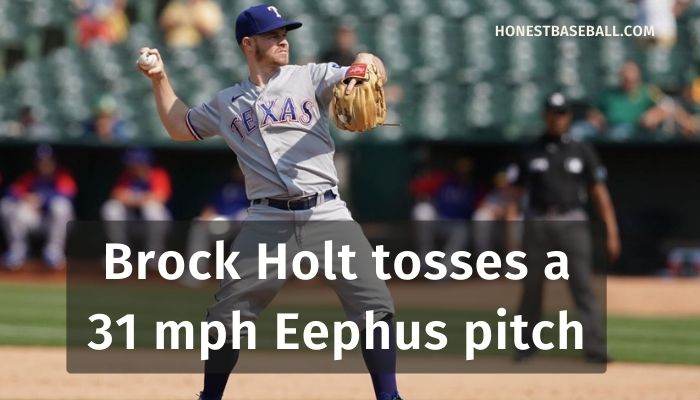
The free-agent Brock Holt, an American pitcher threw some slow pitches with minimum speed for Texas Ranger. As a utility player, he has had done it on August 7, 2021. He threw the lowest speed of eephus pitch at 31.1 mph for a called strike.
The second-lowest Eephus pitch, after Brock Holt, was recorded at a speed of 46 mph. Pitcher Clayton Kershaw of the Los Angeles Dodgers threw this overhand in 2016. Due to the fact that he didn’t do this knowingly, this was not recognized as an official Eephus pitch. In contrast, the ball slid out of his hand before he was ready to throw it.
The second recorded slowest Eephus is recorded beside the name Zack Greinke. He had done this for the Houston Astros in 2021. Greinke threw his slowest pitch with a low speed of 51 mph. It was a strike pitch against the Detroit Tigers.
In the end, the ball ended up through the middle of the strike zone. As the batter got fooled, he didn’t swing the bat.
Yu Darvish threw another Eephus pitch at a pace of 59 mph.
By the way, James LeDux’s study indicates that the Eephus pitches turn at an average speed of about 60 mph.
Brock Holt comes into pitch, tosses 30 mph eephus!:
Ted Williams Clobbered Rip Sewell Eephus Pitch
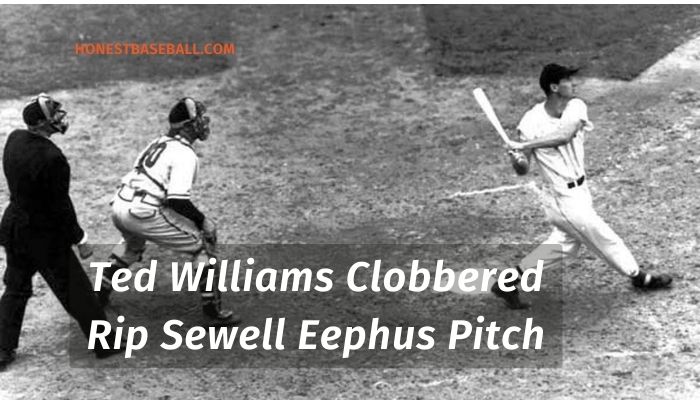
The incident I have mentioned before to talk about the Sewell’s Eephus pitch with Tedd Williams is to be discussed now.
You will be amazed to know that Rip Sewell gave up just a single home run in his career off his Eephus pitch. And this is more fascinating that he did this in 300 Major League baseball matches.
The incident happened in 1946 in the MLB All-Star Game. In the middle of the game, a challenge came from Ted Williams to Rip Sewell to throw an eephus pitch.
In this situation, Sewell obliged a pitch. On the other hand, Williams fouled off the ball.
Then Rip Sewell immediately announced that he is going to throw an eephus pitch on the very next pitch again. In the end, Williams hit the ball and acquired a home run.
Later on, Williams expressed his opinion on that pitch,
“A little girl could hit that pitch, but you had to provide all the power yourself.”
After a few years, Williams recognized that he was running immediately after contacting the ball toward the pitcher’s mound. But, a photograph revealed a shocking truth behind the hit that Williams did with the Eephus pitch Sewell pitched.
The truth is, Ted Williams was a few feet ahead of the batter’s box while he was hitting the pitch. But a batter cannot do that in terms of the Official Baseball Rules of 6.06(a).
The rule says,
“A batter is out for illegal action when he hits a ball with one or both feet on the ground entirely outside the batter’s box, Williams could have been ruled out had it been spotted by the home plate umpire.”
1946 ASG: Ted Williams homers off Sewell’s eephus pitch:
By the way, Tedd Williams is one of the greatest in the history of baseball. We have a list and a brief description of the 100 greatest baseball players. You may check on the detailed guide on the “100 greatest baseball players in baseball history.”
Beyond the 4-Seam: The “Big Three” Eephus Grips
The Honest Truth is that the 4-seam Eephus is actually the easiest for a hitter to track because the rotation is predictable. To truly “pull the string,” you need a grip that kills the spin and makes the ball dance.
Here are the three “Pro” grips used in 2026 to create that signature “nothing” movement.
1. The Palmball Eephus (The “Dead Fish”)
This is the ultimate velocity killer. Instead of holding the ball with your fingertips, you “choke” it deep into the palm of your hand.
- The Mechanic: Wrap all five fingers around the ball and wedge it against your palm.
- The Result: This creates maximum friction upon release, stripping away almost all backspin. The ball doesn’t rotate; it just “tumbles” toward the plate like a dead fish.
- Best For: Absolute maximum speed reduction.
2. The Three-Finger “Lob” (Maximum Control)
If you struggle with the accuracy of a high-arc pitch, this is your go-to. You place your index, middle, and ring fingers across the top of the ball.
- The Mechanic: Think of it like a softball-style release but overhand. The extra finger on top gives you more leverage to “push” the ball upward into the arc.
- The Result: A very high, controlled “rainbow” path that is much easier to land for a called strike.
3. The “Knuckle” Eephus (The Floater)
This is the most dangerous version of the pitch. You dig your fingernails or knuckles into the leather—not the seams.
The Result: This creates a “no-spin” floater. Because there is zero rotation, the air currents take over. The ball might “drift” an extra 6 inches to the left or right mid-arc, making a solid hit nearly impossible.
The Mechanic: Push the ball out of your hand with your knuckles, keeping your wrist completely stiff.
Strategic Mastery: Setting Up the “Ghost Fastball”
In 2026, we don’t just throw an Eephus to get a “laugh” strike. We throw it to weaponize Perceived Velocity. The real danger of the Eephus isn’t the 50-mph “balloon” itself; it’s what that balloon does to the hitter’s brain when the next pitch is a 95-mph heater.
This is the secret of the “Ghost Fastball.”
The “Velocity Gap” Science
The human brain is an elite calculation machine, but it has a “buffer” period. When you throw a pitch at 45 mph, the hitter’s internal timing mechanism has to “slow down” significantly to track the ball.
- The Psychological Reset: After an Eephus, the hitter is mentally stuck in “slow mode.”
- The Ghost Effect: If you follow a 45-mph Eephus with a 90-mph fastball, the Velocity Gap is a massive 45 mph. To the hitter, that 90-mph ball won’t look like 90; it will feel like 105 mph.
- The Result: The hitter’s hands will be late every single time. They are physically incapable of accelerating their swing fast enough to catch up to a standard fastball because their nervous system is still recovering from the “nothing” pitch.
The “Honest” Execution Strategy
To master the Eephus, you must follow the 1:10 Rule. For every 10 fastballs or sliders you throw, you “whisper” one Eephus.
- When to Pull the String: The best time is the second time through the order. Once the hitter thinks they have your “rhythm” timed up, drop the Eephus. It shatters their rhythm and makes the rest of the game a guessing match.
- The Target: Always aim for the top of the strike zone. If an Eephus misses high, it looks like a ball. If it “falls” into the top of the zone, it’s a called strike that leaves the hitter paralyzed.
Coach Butler’s “Honest” Insight: “The Eephus is a setup man, not a closer. Use it to ‘slow down’ the batter’s eyes. Once they’ve seen the rainbow, they’ll never see the lightning coming. That ‘Ghost Fastball’ is the easiest strikeout you’ll ever get.
The Eephus Velocity Gap Calculator: Measure Your “Perceived Velocity
Use this tool to see the psychological impact of your Eephus. Enter your top fastball speed and your Eephus speed to see the “Velocity Gap” and how much faster your next fastball will “feel” to a frustrated hitter!
Eephus Velocity Gap Calculator
Calculate the “Ghost Fastball” effect on your hitters.
Frequently Asked Questions
Why is an Eephus pitch hard to hit?
Basically, hitters get optimized with the speed of the normal baseball pitches velocity. while the hitters are accustomed to the normal delivery, their subconscious mind is ready to cope with the normal velocity.
while the pitcher suddenly reduces the pitching speed, this becomes hard to go with the slow speed. Rather, the batters accustomed to speed play a fast swing here. This makes it hard to hit.
Is Eephus pitch effective?
Yes, an Eephus pitch is highly effective when it is pitched in a proper manner. Because the slow-motion pitch distracts the timing sense of the hitters.
But, you should keep in mind that throwing two consecutive Eephus pitches in a row would be a wrong decision.
Wrapping Up
Eephus is the slowest version of pitch that mostly fools the hitters and distracts their timing and attention. As a result most of the time they miss the pitch and get strikes.
However, Eephus pitches are not always that efficient. You must have a good understanding of when to deliver such a throw. Moreover, you also should not do this in a row as well.
As the Eephus pitch is in baseball for decades, it is one of the most efficient tricks for the pitchers to get a breakthrough.
You May Also Like:
How Long Does A Baseball Game Last Based On The Last 10 Seasons!
Evoshield Catcher’s Gear Review| Supreme Security Behind The Plate
How To Throw A Sinker | Learn From A Coach
How To Throw A Slider Pitchers Throw? Learn The Right Way
Hello everyone. My name is Jason Butler, and I live in California, America. I was a professional AAA Minor League Baseball player. I lost my chance of playing MLB for injury issues, but I did not lose my love for baseball. I attended the coaching training program and am now working as a coach in a small school in San Diego.
I always love to share my experience and knowledge if that can help you. Play baseball, and stay fit.