Last Updated on March 4, 2026
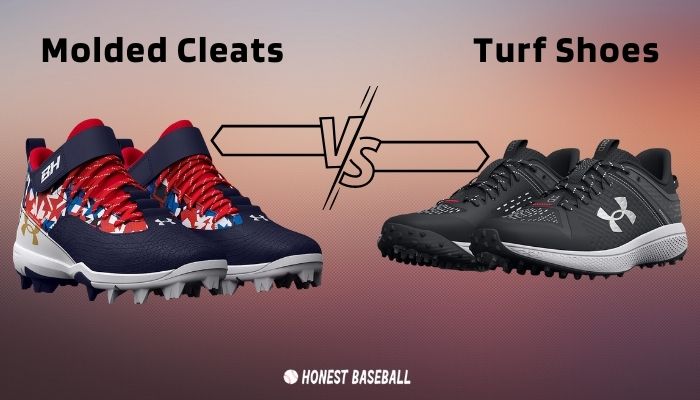
When playing on ground and turf grass, the right pair of shoes, either molded or turf, will help you to get the best traction and performance. Molded cleats are specially made for games, whereas turf shoes are mainly for training.
But, when it comes to molded cleats vs turf shoes, things are a lot to be explained. Because the two types of shoes are made for different purposes. Can you use molded cleats on turf? Are molded cleats better for turf? There are a lot of questions, actually.
So, here I will try to make you understand the purposes of these two types of shoes and where they should be used. Also will show the basic differences between them.
The 10-Second Cleat Matchmaker: Find Your Perfect Shoe
The Honest Cleat Matchmaker
Find the perfect footwear for your game in 10 seconds.
What Are Molded Cleats?
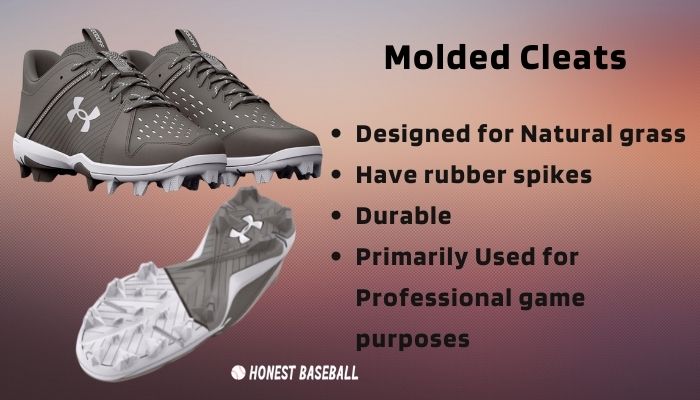
Molded cleats are basically baseball cleats with hard rubber or plastic spikes underneath. Also, molded cleats have rubber soles. Basically, molded cleats are made with a combination of synthetic and mesh materials.
Inside the cleats, there is midsole foam cushioning for comfort. Molded cleats give great traction on baseball ground because of their rubber/plastic spikes.

Molded cleats are lighter than metal cleats and comfortable, no doubt. On the other hand, in most cases, there are more studs in molded cleats than in others. As a result, the weight distribution is better in molded cleats naturally.
In terms of grip, molded cleats are perfect on muddy or soft grounds than hard grounds.
For detailed information on Molded cleats, check out the guide What Are Molded Cleats? Everything You Need To Know
What Are Turf Shoes?
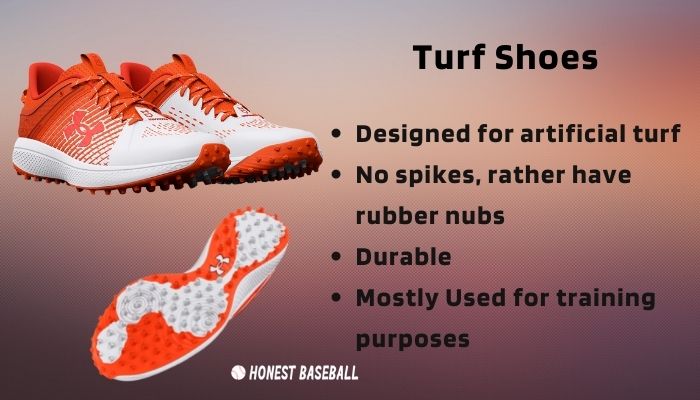
Simply put, training shoes or casual shoes designed specifically for use on grass are what are referred to as “turf shoes.” Turf shoes do not have spikes on the bottom like molded or metal shoes do; instead, they contain rubber nubs or tread patterns. Grass shoes, because they are specifically built for artificial turf, offer superior traction when used on natural turf.
Additionally, turf shoes are more likely to be perceived as casual sneakers as opposed to sports shoes. Turf shoes, on the other hand, provide increased comfort and safety when walking on artificial turf, in comparison to other types of shoes.
Molded Cleats vs Turf Shoes- What Are the Differences?
Beyond the Basics: Surface-Specific Performance Breakdown
To truly decide between molded cleats and turf shoes, you need to understand how each performs under different conditions. The “best” shoe is highly dependent on what the ground looks like—not just the shoe itself.
| Playing Surface | Molded Cleats Performance | Turf Shoes Performance | Best Choice |
| Natural Grass (Dry) | Excellent. Deep studs provide aggressive grip for quick cuts and explosive movements. | Fair to Good. Adequate for general movement, but lack the necessary bite for elite speed. | Molded Cleats |
| Natural Grass (Wet/Muddy) | Superior. The studs penetrate mud to find firm ground, preventing dangerous slips. | Poor. The shallow nubs clog easily with mud, essentially becoming smooth, resulting in zero traction. | Molded Cleats |
| Clay/Infield Dirt (Dry) | Excellent. Provides the crucial stability needed for batting and sharp turns on the bases. | Fair. Can be worn, but offers poor push-off ability and may slip on hard, packed clay. | Molded Cleats |
| Artificial Turf (Dry) | Acceptable, but risky. Adequate grip, but high risk of studs catching and twisting the knee or ankle. | Excellent. The rubber nubs are specifically designed to grip the synthetic fibers and pellets without digging in. | Turf Shoes |
| Artificial Turf (Wet) | Dangerous. The rigid plastic or rubber studs can hydroplane or catch on the slick surface, increasing rotational stress. | Good. Maintains superior grip compared to cleats, but players should still move with caution. | Turf Shoes |
| Dugout/Concrete | Poor. Highly uncomfortable, wears down the studs rapidly, and offers minimal cushioning. | Excellent. Built with a supportive midsole and outsole designed for comfortable standing and walking on hard, non-dirt surfaces. | Turf Shoes |
Okay, now you can understand the basic concept of molded cleats and turf shoes. This will now help you to compare turf shoes vs molded cleats side by side. Here you got to go with the differences and purposes they both serve.
Traction Fact
The first aspect you have to understand is the traction they provide for particular ground. Molded cleats are designed to provide good traction on natural grass. Molded cleats will give you super traction on natural grass with their rubber spikes.
Especially, in muddy ground, and soft natural grasses, molded cleats provide more traction.
On the other hand, turf shoes are designed to give traction on artificial turf with their rubber nubs outsole.
So, the main difference is actually the traction. Both serve great traction on different grounds.
Durability Comparison of Baseball Turf Shoes vs Molded Cleats
In terms of durability, both are super durable and long-lasting. As they serve different purposes, that doesn’t mean one of them will superior to another one.
With proper care, you can use both of them for several years.
By the way, durability also depends on several facts like the surface and players. In this case, molded cleats will go through rough and tough conditions than turf shoes.
Considering this issue, the durability may differ a little. The turf shoes, in this case, may last a little longer time than the molded ones.
Wearing Outside of Fields
Of the baseball turf shoes vs cleats, where can you wear them? Can you wear molded cleats or turf shoes outside of the fields?
Molded cleats have spikes underneath. They are mainly rubber spikes. So, if you walk on a concrete surface or hard surface outside of the natural grass, the spikes will get damaged gradually, which decreases the lifespan of the cleats.
Because spikes are designed to dig into muddy or soft ground to provide traction.
The same thing happens to the turf shoes as well. The rubber and plastic nub will be weak if you walk on hard or concrete surfaces. It is not suggested to walk outside of the recommended surfaces by wearing both molded and turf shoes.
Additional Read: 5 Best Cleats For Pitchers in 2025 | Take your Game to Next Level
Player Position Matters: Tailoring Footwear to the Role
The ideal shoe choice often depends on your specific responsibilities on the field. Personalizing your footwear helps you maximize performance while minimizing fatigue.
Pitchers: The Toe-Drag Factor
Pitchers rely heavily on a strong, consistent push-off point. On a dirt mound, molded cleats are mandatory for maximum torque and drive. However, many pitchers prefer turf shoes for bullpen sessions, practice throws, and general training, as the cushioning reduces the impact of hundreds of pitches. Look for a durable, reinforced toe area regardless of the shoe type you choose.
Catchers: Comfort in the Crouch
Catchers spend long periods squatting or standing on hard-packed dirt or clay. While they need molded cleats for stability when blocking or throwing, the repeated stress on their feet makes cushioning paramount. Turf shoes are indispensable for batting practice, warm-ups, and pre-game drills to save the feet and provide superior midsole support.
Outfielders & Base Runners: Speed and Cuts
Outfielders and aggressive base runners prioritize maximum grip for explosive acceleration and sharp direction changes. Molded cleats are essential for digging in and maintaining top speed on grass and dirt. Turf shoes should be reserved strictly for practice on artificial surfaces or for general field work where maximum lateral grip isn’t required.
Price Comparison of Turf Shoes vs Cleats Baseball
Now we’re talking about something that’s like comparing a laptop to a smartphone. As was discussed earlier, molded cleats and turf shoes are both designed to perform distinct functions on the field of play. Therefore, comparing their prices would be a waste of time.
By the way, turf shoes and molded shoes both come in a variety of price points to choose from. Therefore, the difference in price won’t be that significant here.
Safety Issues
Since sports always tend to be injurious, it’s certain to say which one will cause injury to you. But, the main concern is, you have used the right pair of shoes for the right purposes.
For example, using turf shoes is not a wise decision in natural grasses. On the other hand, using molded cleats on artificial turf is also not recommended. In both cases which are not recommended, you can experience any type of injury.
So, make sure you choose the right pair of shoes for the right surface.
Molded Cleats vs Turf Shoes- An Overview
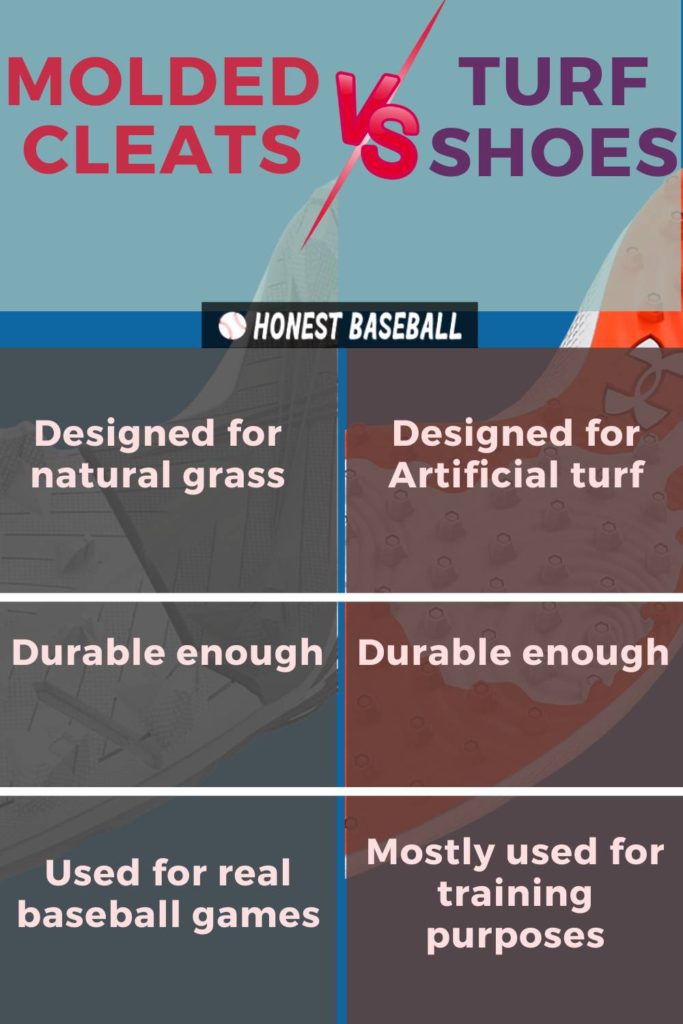
The following comparison table will give you an overview of molded cleats and turf shoes.
| Attributes | Molded Cleats | Turf Shoes |
| Traction | Natural grass | Artificial turf |
| Wearing Outside of Particular Surace | Not recommended | Not recommended |
| Underneath | Spiked | No spikes |
| durability | Durable enough | Durable enough |
| Use | For real games | For training purposes |
Frequently Asked Questions
Can You Wear Baseball Cleats on Turf?
No, you are not recommended to wear baseball cleats molded or metal turf. They will destroy the artificial turf by digging the spikes on the surface. Especially, metal cleats on turf are just a nightmare for the turf.
See Also: Metal vs Molded Baseball Cleats |The Ultimate Comparison
Are Molded Cleats Better for Turf?
No, Molded cleats are not recommended for turf. Because molded cleats are designed for soft and muddy surfaces with natural grass.
Are Rubber Cleats Good for Turf?
Yes, rubber nubs are good for the turf. Turf shoes are made with rubber nubs underneath the sole which is recommended by turf manufacturers.
Final Thought
When we compare molded cleats vs turf shoes, we have to remember that they are made for different purposes. So, in most cases, it’s not wise to compare themselves to pick one between two.
The turf shoes are recommended for artificial turf fields and training. On the other hand, molded or metal cleats are recommended for the natural grassy baseball field.
You Also May Like:
Can You Use Baseball Cleats for Football? Facts and Honest Comparison
Soccer Cleats Vs Baseball Cleats| In Depth Analysis
Can You Use Metal Cleats In High School Baseball | All Facts You Must Know!
Best Baseball Hitting Net To Boost Your Performance in 2025
Hello everyone. My name is Jason Butler, and I live in California, America. I was a professional AAA Minor League Baseball player. I lost my chance of playing MLB for injury issues, but I did not lose my love for baseball. I attended the coaching training program and am now working as a coach in a small school in San Diego.
I always love to share my experience and knowledge if that can help you. Play baseball, and stay fit.