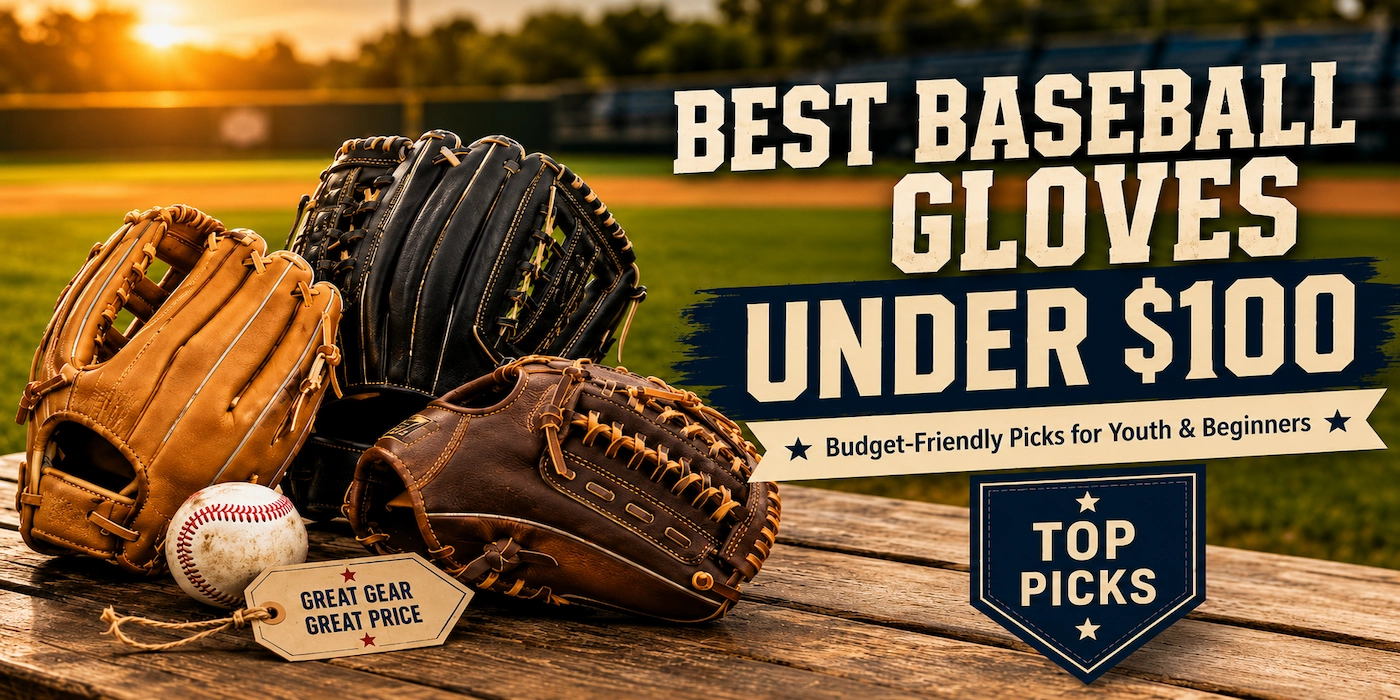
A baseball glove is an important tool for a baseball player. Many students ask me “which are the best baseball gloves under $100”.
Last month, I went shopping with one of my rookies to guide him about the youth baseball gloves. We went through the best cheap baseball gloves as well as the right baseball glove for him. Don’t think low-priced baseball gloves are not perfect for the game. Our honest reviews will change your mind.
That’s when I decided to write this blog about the best baseball gloves under 100.
A glove features cushioned fingers, steerhide leather, and leather lacing. I will tell you where you can find the best baseball glove while buying baseball gloves.
Why And Who Needs Baseball Gloves Under $100
All people should not purchase baseball gloves under $100 for their playing. Only specific type of players and reasons. Let’s know the reasons and persons should use low budget baseball gloves.
1. Cost Effectiveness
High-end baseball gloves cost several hundred dollars. If you are new in baseball or you are purchasing for your child, low-budget baseball gloves are also perfect.
2. Entry-Level or Recreational Use
If you are not a professional player and play baseball only for recreational purposes, you can use baseball gloves under $100. Entry-level players don’t need high end materials and design baseball gloves to play perfectly.
3. Quality Improvements
Manufacturers have improved the production process and decreased the cost of producing baseball gloves. So, you don’t need to think that low budget baseball gloves are low quality.
Best Baseball Gloves Under $100
1. Rawlings Sandlot Series
⚾ The Coach’s Quick Breakdown
- ? Best For: Teenagers and adults wanting a premium vintage look without the premium price tag.
- ⏱️ Break-In Time: 10% Player / 90% Factory (Game-ready instantly)
- ?️ Material: Full-grain oiled pullover leather
- Incredible vintage aesthetic looks like a $250 custom glove.
- Zero padded stiffness; it closes easily right off the shelf.
- Features a padded finger back lining for excellent comfort.
- Because the leather is so soft, it will lose its shape if you don’t store it properly with a ball in the pocket.
?️ Coach Jason’s Verdict: This is the king of the budget category right now. Rawlings absolutely nailed the retro look. If you are playing casual weekend games or coaching your kid’s Little League team, this is the most stylish and comfortable glove you can get for under 80 bucks.
2. Mizuno Prospect PowerClose Series
⚾ The Coach’s Quick Breakdown
- ? Best For: Young kids (Ages 6-10) struggling to squeeze a stiff leather glove closed.
- ⏱️ Break-In Time: 100% Factory Broken-In
- ?️ Material: Pigskin leather (Ultra-soft and lightweight)
- Patented “PowerClose” technology acts like a hinge, making it incredibly easy for small hands to catch the ball.
- V-Flex Notch prevents the leather from bunching up.
- ParaShock palm pad severely reduces sting on hard throws.
- Pigskin leather is not as durable as cowhide; it will likely only last 1-2 seasons.
?️ Coach Jason’s Verdict: The biggest reason kids drop fly balls is because they aren’t strong enough to squeeze the glove shut. Mizuno’s PowerClose tech solves this completely. It is the ultimate confidence-builder for a young player learning to catch.
3. Rawlings Player Preferred
⚾ The Coach’s Quick Breakdown
- ? Best For: Adult softball players and recreational baseball players needing a larger size.
- ⏱️ Break-In Time: 20% Player / 80% Factory
- ?️ Material: Full-grain oiled leather shell
- Available in larger sizes (12.5″ to 14″), making it perfect for slowpitch softballs.
- Features a Velcro wrist strap for a custom, secure fit on any hand size.
- Excellent durability for the price point.
- Heavier than composite/synthetic gloves.
- A bit too bulky for middle infielders who need lightning-fast ball transfers.
?️ Coach Jason’s Verdict: Go to any local slowpitch softball game, and you will see half the team wearing this glove. It is a workhorse. The Velcro strap is a fantastic touch, allowing you to tighten it up if you have smaller wrists.
4. Wilson A500 Series
⚾ The Coach’s Quick Breakdown
- ? Best For: Youth travel ball players (Ages 8-12) looking for a real leather feel without the heavy weight.
- ⏱️ Break-In Time: 100% Factory Broken-In
- ?️ Material: Top Grain Leather (Extremely lightweight)
- Modeled after the famous Pro Stock A2000 patterns, giving it a pro-level shape.
- The lightest all-leather glove on the market, increasing a kid’s reaction time.
- Double palm construction keeps the pocket stable and wrinkle-free.
- Not enough padding for catching hard-throwing high school pitchers.
?️ Coach Jason’s Verdict: I always recommend the A500 to my 10U players. It teaches them how a “real” leather baseball glove should feel and form to their hand, but it’s light enough that it doesn’t drag their arm down on ground balls.
5. Franklin Sports Field Master
⚾ The Coach’s Quick Breakdown
- ? Best For: Absolute beginners, backyard catch, and parents on a super tight budget.
- ⏱️ Break-In Time: Ready instantly
- ?️ Material: Synthetic Leather (Polyurethane)
- Unbeatable price point (often hovering around $25 – $35).
- Contour fit system allows for easy thumb adjustments.
- Completely weatherproof; you don’t have to worry about ruining the leather in the rain.
- Synthetic material feels slightly “plastic-y” compared to real cowhide.
- Will eventually crack/tear under heavy, competitive use.
?️ Coach Jason’s Verdict: Look, if your kid just decided they want to try baseball tomorrow and you don’t want to risk $100 on a sport they might quit in two weeks, buy this. It is the #1 selling glove on Amazon for a reason—it gets the job done for backyard fun without breaking the bank.
Buyer’s Guide for Softball and Baseball Glove
You should keep in mind that not all gloves are the same. Every type of glove has its own need, want, and demand. Following are the parts to be considered while you are buying a glove for yourself or someone else.
Size & Type Of The Glove
A baseball glove is not just for the pitcher or the catcher. Mitt can be of four kinds. Depending on the nature of the mitt, size can differ.
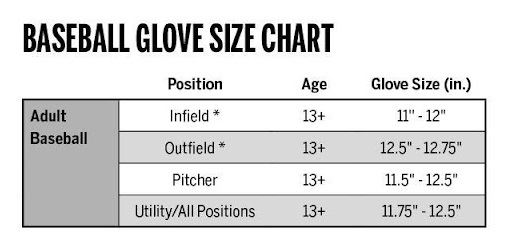
It is a general idea that smaller gloves fit better on hands but it is not true.
- Infield gloves are smaller and used by infielders. Rather than catching the ball, their main aim is to provide quick passes from one player to another.
- Outfield gloves are used in the outfield. They are bigger in size and made to catch the balls easily. They have pockets deeper than other gloves.
- A pitcher’s glove is made for pitchers. They have pockets to hold the ball comfortably for the pitcher and throw without any problem. They have designs that closely hold the ball.
- Utility gloves come in different shapes and sizes. These gloves are used by those who change their roles in the field from time to time.
These are mainly different kinds of sizes and types of the gloves. You should know the role of the player for whom it is being bought.
Material
As I have shown already, materials differ from glove to glove. The right glove should have the right material according to your need. Leather gloves are best for durability and break-in. Synthetic leathers also have good durability. They are also easy to break in. But they are not as durable as leather gloves. But they have lower prices.
| Glove Type | Durability |
| Cowhide Leather | ***** |
| Artificial Leather | **** |
| Pigskin Leather | *** |
On the other hand, pigskin gloves are very popular for those who look for a soft touch. But they have less durability than other gloves.
You should choose the material according to your preference.
Pocket & Palm With Fitness
Pocket and palm both are important for a glove. You should be very careful when you make the decision of buying a glove on these points.
Deep pockets are for those who need a better grip on the ball.
The palm should be made with padding in such a way that it will not let the palm get shocked by the ball’s force.
Choose correctly to get the best out of the glove.
The right baseball glove for you should fit perfectly on your hand. Elastic band, contour fit or lining whatever the way to fit should be comfortable for you.
Choose the best baseball glove which fits your hand perfectly.
Break-in of a Baseball glove
This is a very interesting part of buying a baseball glove. A glove can be advanced break-in by the company. It can be 50-60% already break-in done or you need to completely break in the glove.
Let’s see my preferred method for the break-in of a baseball glove.
You will need a break-in set for the glove. I prefer Wilson Glove Conditioner Set or Hot Glove Set for the break-in.
Besides, you can also use just warm water, a yoga mat, and a baseball bat and ball.
If you got the glove wet, then you can also know how to dry a wet baseball glove from our blog.
First, pour warm water or conditioner on the glove. Then bend the thumb and the pinky keeping it on the mat. If you are using a kit then use the belt to bend them and keep tight.
Otherwise, beat them up with the bat or the stick. Beat again and again until they feel softer.
Bend the glove and open it.
Put the stick or the bat inside the pocket to make it deeper. Beat around the pocket.
Play catching some balls with it.
Beat the glove again and keep it for one day.
The next day beat again and play some catch with it and see the difference.
Many people do it for once and keep it as it is. But I prefer a two-day break-in.
Frequently Asked Questions
How much does a good glove cost?
Answer: A good glove can cost from $40-$500 depending on the material, brand and everything else. If it is a youth glove then it may cost lower. Pro gloves always cost higher.
How do pros break in their baseball gloves?
Answer: Pros break in their gloves with warm water. Some of them use kits or put the gloves in a microwave oven. Most recommended is to use conditioner and warm water.
Is an 11.5-inch glove too small?
Answer: 11.5-inch glove is small but it is the baseline length for the infield gloves. You can use it for the infield. Outfield gloves tend to be bigger than infield gloves.
Conclusion
Not all the high-end or highest-quality material gloves are best for you. Only the best material which makes you feel comfortable and fit on hand and lets you catch the ball without any problem is the best one for you. Even if it is not a high-priced one. So pick it up carefully and break in with enthusiasm. You only deserve the best for yourself.
Hello everyone. My name is Jason Butler, and I live in California, America. I was a professional AAA Minor League Baseball player. I lost my chance of playing MLB for injury issues, but I did not lose my love for baseball. I attended the coaching training program and am now working as a coach in a small school in San Diego.
I always love to share my experience and knowledge if that can help you. Play baseball, and stay fit.