In 2026, throwing hard isn’t enough. If your fastball is straight, elite hitters will time it by the third inning. The Two-Seam Fastball is your ‘Contact Killer.’ It’s the pitch that turns a 95-MPH exit velocity into a weak ground ball to shortstop. This guide isn’t just about the grip; it’s about mastering the Seam-Shifted Wake and fingertip pressure to make the ball ‘fall off a table’ as it reaches the plate
For my students, I help them to learn to throw a two seam fastball at the beginning level. And not to build up the velocity but for the slight curve. Because for them, more than 50 mph is enough. On the other hand, if you are starting at a higher level, try to have at least 86 mph.
In this article, I will help you learn to throw a two seam fastball step by step.

What is a Two Seam Fastball
This two seam fastball is a pitching style in Baseball and Softball. This fastpitch can go right or left, depending on your throwing angle and arm.
For example, if you throw the fast pitch down the middle, then a right handed pitcher can send it to the left. On the other hand, a left handed throw can send it to the right. Or it can be vice versa if you can change the angle.
The slight curve can distract the hitter from swinging the Baseball bat.
Do you know the difference between a Slider and a Curveball? Follow this link to know|| Difference between a Slider and Curveball
The “Skill Gap” Matrix: Is the Two-Seamer Your Missing Link?
Before you learn the grip, you need to understand if the Two-Seam Fastball is the right tool for your current “arsenal.” In 2026, we don’t just throw pitches because they sound cool; we throw them to solve specific problems on the field.
Use this matrix to see if your game has a “Skill Gap” that the two-seamer can close:
| If Your Problem Is… | The Two-Seam Solution | The “Honest” Why |
| “High Fly-Ball Rate” | The Ground-Ball Inducer | The late “sink” forces hitters to make contact with the top half of the ball, resulting in easy-to-field grounders. |
| “High Pitch Counts” | The “Contact Killer” | This isn’t a strikeout pitch; it’s an efficiency pitch. It’s designed to get an out in 1-2 pitches, keeping your arm fresh for the late innings. |
| “Small Hands / Young” | The “Offset” Grip | Unlike the Four-Seam, which requires a wide grip, the Two-Seam can be “offset” slightly, allowing smaller fingers to find leverage on the seams. |
A Quick “Honest” Reality Check:
If you are a pitcher who lives and dies by the “High Fastball” and the “Swing and Miss,” you might actually want to stick with your Four-Seamer.
But, if you are tired of seeing 350-foot flyouts and you want to start “shoving” into the 6th and 7th innings with a low pitch count, the Two-Seamer is your new best friend.
Grip 2.0: The “Fingertip Pressure” Secret
If you just hold the seams and throw, you’re basically throwing a “bad” four-seamer. To get that elite, late-breaking “tail” or “sink,” you have to master Active Pressure. This is what separates a BP fastball from a front-door strike.
The “Honest” Tip: It’s All in the Pointer Finger
Most young pitchers try to “twist” their wrist to make the ball move. Don’t do that. Twisting leads to inconsistency and elbow strain. Instead, the movement comes from your fingertips at the final millisecond of the release.
- The 10% Rule: For a right-handed pitcher looking to move the ball away from a leftie or into a rightie, apply roughly 10% more pressure with your Index (Pointer) Finger than your middle finger.
- The “Pull” Effect: This slight imbalance in pressure causes the ball to exit the hand with a subtle “tilt” on its axis. As the ball travels, the air catches those two narrow seams and pulls the ball toward your arm side.
The Visualization: “Cut the Ball in Half”
Mechanical cues are hard to remember in the heat of a game, so I tell my players to use a simple visualization:
“Think about cutting the ball in half with your pointer finger as it leaves your hand.”
When you focus on “cutting” the ball, your hand naturally pronates (turns slightly outward). This creates that beautiful, late-inning “tailing” action that makes hitters look like they’re swinging at a ghost.
How to Practice the “Feel”
Don’t go to the mound yet.
- Sit on your couch with a ball.
- Grip it in your Two-Seam setup.
- Flick the ball into your other hand, focusing only on the pressure of that index finger.
- If the ball spins with a slight tilt toward your thumb, you’ve nailed the “Fingertip Pressure” secret.
The Two Seam Fastball Pitching Grip
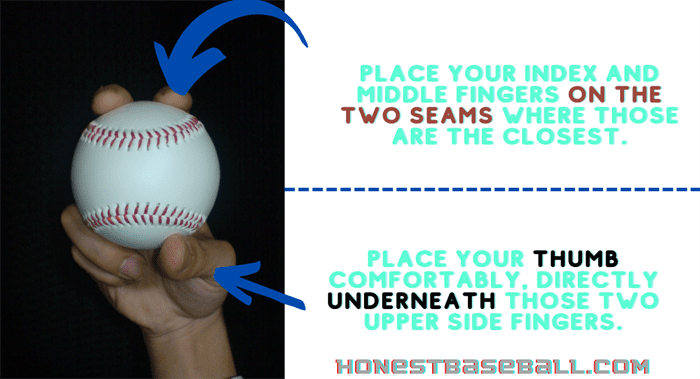
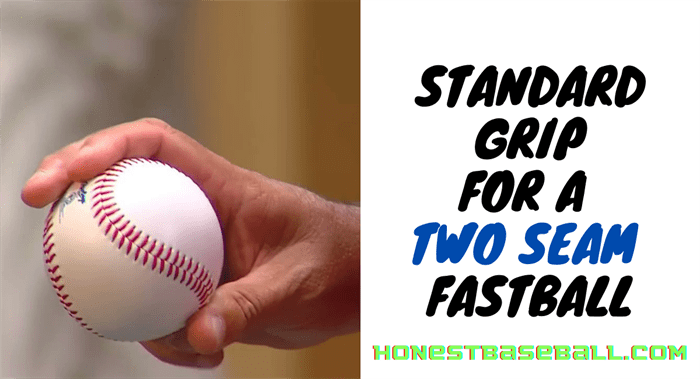
The grip is the first thing you need to know before learning to throw a two seam fastball pitch. If you have a perfect grip, then you can throw good pitches. Well, there is no fixed rule or style to grip a Baseball for a two seam fastball pitch. But at the beginning, try the following steps-
- First, place your index and middle fingers on the two seams where those are the closest.
- Then place your thumb comfortably, directly underneath those two upper side fingers.
The Release of Two Seams Fastball
Every player is unique and has a different body measure. So, you can follow the steps and develop the perfect positioning and angle for your pitch. But a minimum strength in your pitching arm is necessary.
While you want to release the ball like a two seamer, try to give it a 360-degree rotation on the X-axis.
And always remember, do not grab the ball as it can touch the palm of your hand. Do not hold the ball deep inside of your hand. Try not to put more pressure on your thumb underneath than your index finger and middle finger. Just make it a firm grip. Otherwise, the throw will require more hand movements and techniques.
During the release, flow the strength from your pitching hand to the tip of your index and middle fingers. Make good coordination with your arm slot. And put more pressure on the ball from your index finger. These steps will help to make the ball spin.
Now, let’s analyze the after release point.
Do you know how many stitches made the seams on the Baseball, if you do not know, follow this article || How many stitches on a Baseball
The after Result of the Release

If you throw two seamers according to the mentioned steps, the ball will have an excellent off-center spin. It will travel towards the home plate, having a slow downfall.
The ball will have a left-to-right slight curve if you are a right handed pitcher. And if you are a left handed pitcher, the ball will have a right-to-left slight curve. a
During the release, if you can give the ball a high horizontal break, it will be a running fastball (a referral name), which has a higher velocity than a standard two seamer. Otherwise, it will lose some momentum and move downward more.
Effectiveness of Two Seam Fastball Pitch
This pitching requires more movement and technique than any other pitching. As I said, players differ in their arms strength, finger point pressure, and body coordination. And the pitch’s break point, efficiency, and velocity generation on those qualities.
Well, if being honest, throwing a two seamer is not a problematic high-level pitch. It is very natural and mostly taught at the beginner level.
The velocity also gets different at various levels. In the Little League, it can roughly touch 50 Mph. On the other hand, at the collegiate level, it can be lower than 90 Mph if the stats go to more advanced big league pitches like Major League. It can reach up to 95 Mph. Big league pitchers spend far more time preparing to pitch than pitching.
So, two seam fastballs can be very effective and have a great pitch at the right time.
Extra Gripping Style for Two Seam Fastball
Suppose two seams fastball pitch’s stereotype grip is rugged for you. Then you can alter the gripping a bit.
For example- you can have a close finger placement. Like in a standard grip, you place your index and middle finger on the seams. But here, you put both the fingers together in the center space of the seams.
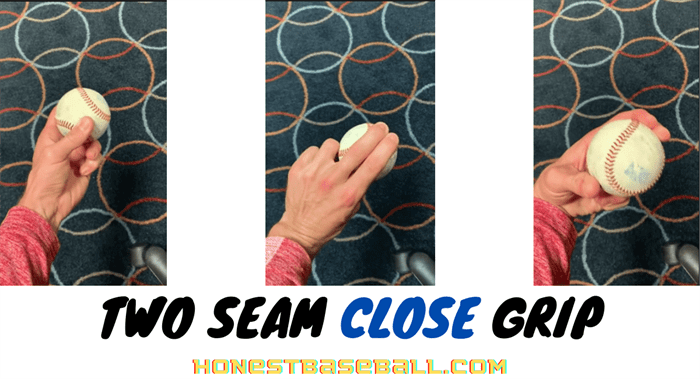
Or, you can put your index and middle fingers on the space. As a result, these two fingers will be in the seams with the vastest distance.
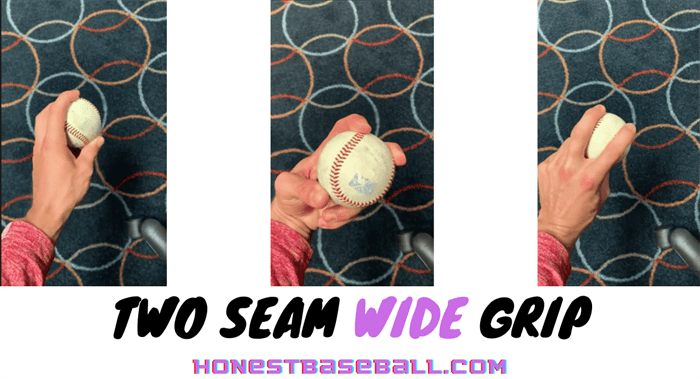
You can join some workout programs if you want to develop your gameplay by adding velocity to the ball. This workout will help you make extra movement and make the probable diagnosis. Then the program will give solutions to your barrier according to the constitute medical advice.
Most pitchers do this to increase their gameplay. And many pitchers are adding to workout programs more than in the past.
Greg Maddux was a former pro pitcher famous for his two seam fastball grip and the pitch. For more inspiration, let’s know more iconic players who are very good at two seams fastball pitch.
Three Pitchers Who was Known for Two Seams Fastball
1) Tim Lincecum
He was mainly a four seam fastball pitcher. But Tim usually threw two seams just to get more ground balls.
2) Kyle Lohse
Kyle was a two seam fastball pitcher and his average throwing speed was 91 Mph.
3) Gerrit Cole
He was a power pitcher and mostly threw in four seam and two seam. Average two seam pitching velocity was near 100 Mph.
Now if you want to be a better hitter so that you can hit even the hardest two seamer pitch, read this article || How to become a Better Hitter
2026 Situational IQ: When to Pull the Two-Seam Trigger
Having a nasty two-seamer is only half the battle. Knowing when to throw it is what separates “throwers” from “pitchers.” Test your IQ with these three game-day scenarios.
Scenario 1: The “Bases Loaded” Jam
The Situation: Full count, bases loaded, 1 out. A power hitter is at the plate looking for something to drive deep.
The “Honest” Reason: You aren’t looking for a strikeout here; you’re looking for a double play. A four-seamer stays “true” and is easier to loft into the outfield for a sacrifice fly. The two-seamer’s late sink induces weak contact on the top half of the ball, leading to a routine “6-4-3” double play to escape the inning.
Scenario 2: The “Leadoff” Battle
The Situation: Top of the 1st, 0 outs. You’re facing a speedy leadoff hitter who likes to “slap” the ball and use their legs.
✅ The 4-Seam Fastball (Initially).
The “Honest” Reason: Don’t show your “movement” pitch too early. Establish your velocity and “ride” with the 4-seamer up in the zone first. Once they are timed up on your straight heat, pull the string with a 2-seamer at the knees on the third or fourth pitch to catch them off guard.
Scenario 3: The “Windy Day” Advantage
The Situation: You are pitching on a day with a heavy crosswind blowing toward your “arm-side.”
✅ The 2-Seam Fastball.
The “Honest” Reason: Use the elements to your advantage. In 2026, we call this “Environment-Aided Movement.” If the wind is already pushing the ball toward your arm-side, your two-seamer will have 2–3 inches of extra “run.” It makes a standard pitch look like a “Wiffle Ball” to the hitter.
Frequently Asked Questions
How do you detect a four seam and a two seam fastball pitch?
ANSWER: A four seam goes straight to the home plate. On the other hand, a two seam travels with a 1slight curve according to your throwing angle.
Why is it called a four seam fastball?
ANSWER: Well, when you throw a four seam fastball pitch, all the four seams come into view with every relation. Of Course, you will need a slow-motion camera to see that.
Is a sinker a two seam fastball?
ANSWER: Both have similarities, but definitely, they are different. If you think of them as similar is one of the big misconceptions. A sinker ball drops more than a two seam fastball. And the sinker does not get the slight curve like a two seam fastball.
The Last Thought
Do you know a two seam fastball and a four seam have similarities? If you see that it’s good. But while you throw a pitch, do not mix up these two.
Remember, if you want to adopt a two seam fastball pitch, it is better to start early. And do not copy other players. Just follow the basics and make your perfect style.
I hope this will help you learn how to throw a two seam fastball. And after trying, if you think a 2 seam fastball is not for you. Then not to worry, as there are more best pitching options to adopt in Baseball. Like a four seam fastball.
Good Luck.
Hello everyone. My name is Jason Butler, and I live in California, America. I was a professional AAA Minor League Baseball player. I lost my chance of playing MLB for injury issues, but I did not lose my love for baseball. I attended the coaching training program and am now working as a coach in a small school in San Diego.
I always love to share my experience and knowledge if that can help you. Play baseball, and stay fit.