
As young baseball players graduate from youth leagues to the competitive fields of high school, one common question often sparks debate: ‘Can you use metal cleats in high school baseball?’ It’s a critical question for both performance and safety, and the answer isn’t always as simple as a yes or no.
As a former AAA player and coach, I’ve seen firsthand how the right footwear impacts a player’s game, and understanding the rules and reasons behind them is crucial. Let’s break down everything you need to know about metal cleats at the high school level, from the regulations to performance advantages and vital safety considerations.
What Are Baseball Cleats?
Baseball shoes are more like soccer or football shoes. They come with a thick and cleated outsole. Those spikes are actually called cleats. However, baseball cleats are a bit shorter than those you see in other sports shoes.
Cleats are not just a common sight in high school baseball. Professional athletes also rely on them to help them play their best game possible.
When running, cleats give you more traction and makes it easier to grip the ground when making a pivot. Baseball cleats also help players dig into the ground when swinging.
You can find several different types of baseball cleats out there, including metal spikes, molded rubber or plastic cleats, and turf cleats.
Why Should You Wear Metal Cleats?
Like most sports, the right equipment can give you a competitive edge in baseball too. But are metal cleats better for baseball? Well, they are helpful in some ways. Here are the reasons why you should wear metal cleats:
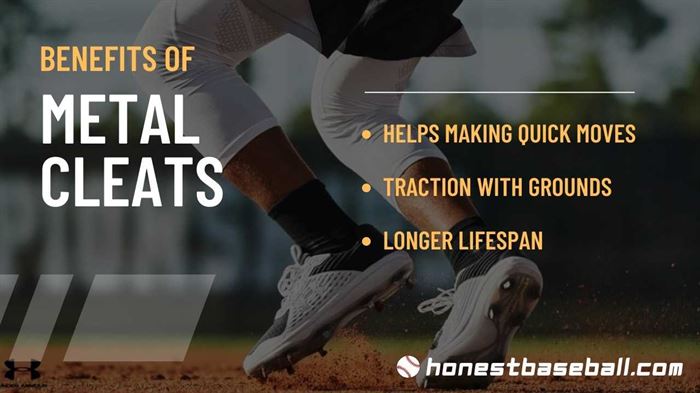
- They provide good traction on both grass and dirt surfaces, which can help you make quick cuts and sprints.
- Metal cleats have a longer lifespan than other types of cleats. They can handle tough play without wearing down quickly like some other types of cleats might.
- For getting more stability and support, metal cleats are a great choice.
- As you get a good grip on the ground, you can achieve a better grip on the bat, which can improve your batting accuracy.
- Without the above, metal cleats are preferred by many pro-league batters, especially when they are on a full walk off aggression.
While there are some variations among different types of cleats, they all serve a common purpose: to improve performance and safety on the field.
Metal cleats provide a number of advantages depending on your roleplay, especially in the hardest positions on the baseball ground.
Metal Cleats For Infielders
Infielders need the best traction possible to make quick and accurate throws. Metal cleats provide the right grip on the field and are less likely to get stuck in mud or sand. They also protect the feet from injury because of their thicker sole nature.
Metal Cleats For Outfielders
This is important for outfielders, who often have to make plays in difficult conditions. Metal cleats allow players to move more quickly and change direction more easily.
The facility is critical in making catches or getting to ground balls before the opposing team does.
Metal Cleats For Pitchers
Baseball is a game of inches. And in the heat of competition, even the slightest advantage can make all the difference.
That’s why metal cleats have become an essential piece of equipment for pitchers, who need every possible edge they can get to gain an advantage over the batter.
Metal cleats provide more traction than traditional rubber cleats, allowing pitchers to plant their feet more firmly on the ground and get more leverage on their pitches.
This extra grip also helps them keep their balance in different pitching styles, such as the cutter pitch.
Top Baseball Players With Metal Cleats

The Rules: NFHS & Beyond – When are Metal Cleats Allowed in High School Baseball?
This is often the million-dollar question for players and parents transitioning into high school baseball, and for good reason! The rules around cleats change significantly once you leave many youth leagues.
The Direct Answer: Yes, NFHS Allows Them!
Let’s cut right to it: The National Federation of State High School Associations (NFHS), which governs most high school sports rules in the United States, does permit the use of metal cleats for baseball at the high school level. This means, generally speaking, when you step onto a high school baseball field for a sanctioned game, metal spikes are on the table.
Why the Change from Youth Leagues?
You might be used to youth leagues like Little League, Babe Ruth, or Cal Ripken where metal cleats are strictly prohibited. The reasoning for allowing them at the high school level stems from a few key factors:
- Increased Level of Play: High school baseball is faster, more competitive, and demands a higher level of athleticism. Players are bigger, stronger, and running faster. Metal cleats provide superior traction on dirt and natural grass, which is crucial for quick bursts of speed out of the batter’s box, rapid changes of direction in the field, and a firm push-off on the pitching mound.
- Player Development & Awareness: By high school, players are generally more developed physically and possess a greater understanding of proper sliding techniques and field awareness, which helps mitigate some of the safety risks associated with metal cleats.
Crucial Caveat: Always Check Local and State Rules!
Now, here’s the really important part, and it’s a common point of confusion: While NFHS sets the national standard, individual state high school athletic associations, local school districts, or even specific tournaments and leagues can (and sometimes do) adopt their own modified rules.
This means that even if NFHS allows metal cleats, your particular state or local league might have a specific bylaw that prohibits them, especially for junior varsity (JV) teams or at certain age levels within the high school system. For example, some states might have a rule that only varsity players can wear metal, or that specific districts might have molded-only rules for all levels.
Your absolute first step should always be to consult your coach or athletic director, or directly check your team’s or league’s official rulebook for the current season. Don’t assume – always verify! Doing so ensures you’re compliant, safe, and ready for game day without any last-minute surprises.
Disadvantages Of Metal Cleats
As a manager, I often saw many amateurs decide to switch to metal cleats without knowing the other side. Using metal cleats does not only offer you benefits. There are some disadvantages too.
So, I always advise my team to understand these facts below before switching to metal cleats.
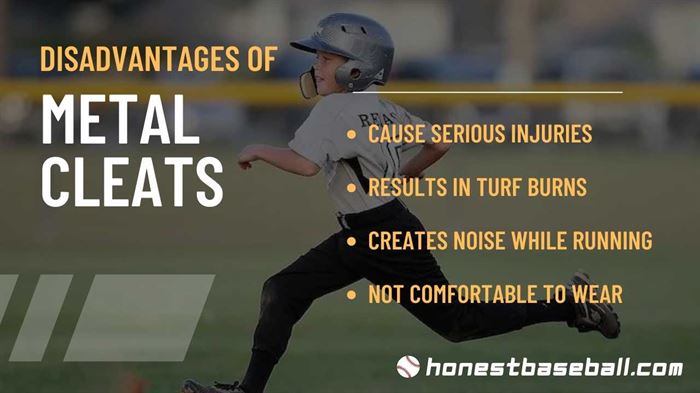
The first disadvantage is that metal cleats can cause serious injuries if they come into contact with another player’s skin.
They can also lead to more turf burns since they grip the ground more tightly than traditional cleats.
Additionally, metal cleats can be quite loud, which can be distracting for both players and spectators.
Lastly, they tend to be heavier and less flexible than other types of cleats, making them more difficult to wear for long periods.
If you are confused between molded and metal cleats, check out this comparison article of metal and molded cleats.
Why Are Metal Cleats Not Allowed?
Metal cleats are not allowed in some tournaments because they can cause too much damage to the playing surface.
The cleats can tear up grass fields and even concrete surfaces, leading to costly repairs. In addition, metal cleats can be dangerous for other players if they get in contact with them.
Just like restrictions with metal cleats, some bats are also not permitted in baseball. Find when a baseball bat is considered illegal in this article.
How To Remove Metal Cleats From Baseball Shoes?
Yes! You can change or replace metal cleats from baseball shoes. In order to do that, follow the below instructions.
Required Components:
- Cleaning Brush
- Paper Towel
- New Metal Cleats
- Cleat Wrench
Step 1: Clean The Soles & Cleats
You need to wash down your cleats to get rid of dirt in the first step. Use a stiff-bristled brush with a q-tip or paper towel to scrub the bottom of the shoe. Do a concentrated brushing near the cleats.
Step 2: Eject Worn Cleats
Now start rotating the worn cleats counterclockwise to eject them from the shoe’s sole. You may see some dirt still left under the cleat area where the brush couldn’t reach. So, brush there again.
Step 3: Align New Cleats
Count how many cleats you need. In general, replaceable cleats packs come with multiple units more than what you require. Now pick the newly brought metal cleats.
There are usually two components in good metal cleats – cleat piece and fastener. Now place a cleat in the receptacle. Make sure to align the notch on the heel side of your baseball shoe. The fasteners will rise out of the cleats when you try the alignment.
Step 4: Torque Cleats
Next, use the cleat wrench to tighten the fastener. When fastening, ensure that the cleat piece is in the right position.
After finishing up the fastening, double-check whether the alignment notch is positioned towards the heel side of your shoe. Lastly, repeat the same steps for every cleat.
Choosing the Right Cleats for You: Metal vs. Molded
So, you’ve understood the rules and the pros and cons of both metal and molded cleats. Now comes the practical part: how do you decide which pair (or pairs!) is right for you or your high school player? It’s not a one-size-fits-all answer, as several factors come into play.
Let’s break down a “decision matrix” to help you make the best choice:
1. ALWAYS Check Your League Rules FIRST! (This is Non-Negotiable)
Before you even think about performance or preference, this is your absolute top priority. As we discussed, while NFHS generally allows metal cleats in high school, local leagues, state athletic associations, or even specific tournaments can have different rules.
- Action Step: Get a copy of your league’s official rulebook or confirm directly with your coach or athletic director. If metal cleats are prohibited, then your choice is simple: molded cleats are your go-to. Don’t risk disqualification or, more importantly, injury to yourself or others by disregarding the rules.
2. Consider Your Primary Playing Surface
The type of field you play on most often is a huge factor in cleat selection.
- Natural Grass & Dirt Fields (Traditional Baseball Diamonds): This is where metal cleats truly shine. Their sharp, thin spikes dig deep into the turf, providing unparalleled traction for explosive pushes off the mound, quick cuts in the infield, and powerful drives out of the batter’s box. You’ll feel incredibly “locked in” to the ground.
- Artificial Turf Fields (Many Modern Fields): This is where metal cleats are almost universally a no-go. They can damage the turf, become slippery on the harder surface, and significantly increase the risk of knee and ankle injuries due to getting “stuck” when trying to pivot. For artificial turf, molded cleats are a much safer and more effective option. Many players opt for specialized turf shoes for maximum comfort and traction on these surfaces, especially for practice.
- Mixed Surfaces: If your team practices on turf but plays games on grass, or if you regularly encounter fields with patches of artificial turf, having both metal and molded (or turf) options is often ideal.
3. Evaluate Your Playing Position
While all positions benefit from good traction, some roles get a more significant edge from metal cleats.
- Pitchers: Metal cleats offer a superior anchor on the pitcher’s mound, allowing for a more powerful and stable push-off into the delivery. This can translate directly to velocity and control.
- Aggressive Base Runners: If you’re looking to steal bases or get out of the batter’s box like a rocket, the immediate, aggressive grip of metal cleats gives you a definite advantage in acceleration.
- Infielders & Outfielders: For quick lateral movements, explosive first steps, and sudden stops or changes of direction, metal cleats provide that extra bit of bite into the ground, reducing slips and improving agility.
- Designated Hitters/Less Active Roles: While still beneficial, if a player is primarily a DH or has less emphasis on explosive field movement, the absolute necessity for metal might be slightly lower.
4. Personal Comfort and Preference
Believe it or not, feel matters!
- “Feel” for the Ground: Some players simply prefer the sensation of metal cleats gripping the dirt. Others might find them uncomfortable or feel the individual spikes too much.
- Weight: While cleats are constantly getting lighter, there can be slight differences in weight that some players notice.
- Break-in Time: Both types require some break-in, but the feel on your feet will differ.
Ultimately, if allowed, try them on. Walk around. Do some light movements if possible to see how they feel on your feet.
5. Consider Your Budget
Cost is always a factor, especially when dealing with growing feet!
- Metal cleats often come at a slightly higher price point than molded cleats, and replacement spikes can add to that cost over time. Factor this into your decision, especially if you anticipate needing multiple pairs or frequent replacements.
The Honest Recommendation: Be Prepared for Anything
Given the varied rules and playing surfaces in high school baseball, the most valuable advice is often this: If your league rules permit, a high school player should ideally have access to both a pair of metal cleats and a pair of molded (or turf) cleats.
This allows you to:
- Comply with all rules, no matter where you play.
- Maximize performance based on the specific field conditions (natural grass vs. artificial turf).
- Prioritize safety by using the appropriate footwear for each surface.
Understanding these factors will not only help you choose the right cleats but also ensure you’re stepping onto the field safely and confidently, ready to play your best game.
Frequently Asked Questions
Are Metal Cleats Allowed In Little League?
That is a question that I hear a lot every season from new players on my team. The answer is yes for seniors and no for juniors. According to the Little Leagues rulebook, you can only use molded baseball cleats. They explicitly banned using metal cleats.
Even for seniors, there are some restrictions. Metal cleats can only be worn in games, not in practice. However, you can wear plastic or rubber cleats in Major, Minor, and Tea Ball.
Are Metal Cleats Allowed In Softball?
In the common softball scenario of most of the junior leagues or tournaments, you cannot use metal cleats. This is nothing but for players’ safety.
But they are allowed in Junior Olympic softball under 14U, 16U, and 18U divisions, both for slowpitch and fastpitch softballs.
Can You Wear Metal Cleats In 13U Baseball?
Yes! The permitted age for using metal spikes and toes is 13U and above players in baseball. Both of the prominent federations of baseball, NCCA, and NFHS, have allowed this.
Conclusion
Can you use metal cleats in high school baseball? Hopefully, you get your answer. I will not say metal cleats are bad or good. Because all types of cleats have pros and cons but somehow serve the same purpose.
I will also not argue with the decision of NFHS on restricting metal cleats for under 13 years of players. As baseball is a rush sport, often players get close interactions during the play.
Metal cleats can cause injury then, especially in high school baseball tournaments. So, what is your thought about metal cleats?
Hello everyone. My name is Jason Butler, and I live in California, America. I was a professional AAA Minor League Baseball player. I lost my chance of playing MLB for injury issues, but I did not lose my love for baseball. I attended the coaching training program and am now working as a coach in a small school in San Diego.
I always love to share my experience and knowledge if that can help you. Play baseball, and stay fit.