
If you want to become a great pitcher, who is mechanically, mentally, and physically sound, you must do a lot of practice with pitching. And if you have good control over your pitches, then pitching accuracy drills will add another level to your deliveries.
As a result, the pitching drills for accuracy in baseball come. If I need to talk about how to improve pitching accuracy in baseball, you need a lot of drills to do so.
For example, you have a great pace in your throwing. But, inconsistency and poor control over them can make it good for nothing.
But, if you go through consistent drills like a warm-up, balance drill, velocity drill, mechanical development, physical conditioning, mental health process, and so on, you could be able to master the pitching.
So, let me allow myself to talk about some great baseball and softball pitching drills for accuracy. Let’s move together.
What Makes a Great Pitcher?

Before getting into the drills, let’s find out what makes a good pitcher. There are several attributes that should be on a pitcher, that verify him as a good pitcher.
Accuracy in throwing, good pitching velocity, pitching movement, a strong pair of arms, and mental strength are some of the very important characteristics to have in a good pitcher.
Things needed to be clarified and explained for a better understanding.
Accuracy

If you see, our main goal is to let you learn the drills for pitching accuracy. Actually, having accuracy is the most important to-have attribute of a good pitcher. Intense accuracy separates you from an ordinary pitcher.
As a pitcher, you must know where to locate your pitches. You have to be capable of throwing the ball in a good location. It needs consistency to pitch in the same place every time.
If the thing happens another way, remember, you will have some hitting nightmares. Without great accuracy, hitters will just make your pitches far from the plate.
So, to become a great pitcher, earn great accuracy in your pitching.
Good Pitching Velocity
If you come with the velocity of pitching, you will find some great pitchers with high velocity. In more simple terms, great velocity in pitching is a specialized skill that all pitchers don’t have.
As a result, the higher the velocity, the harder the pitcher is with great accuracy and speed. Even, higher velocity can make up for a mistake pitch as well.
For example, if a pitcher throws a pitch that doesn’t go down the right path, he wants to In this case, a 75 mph pitch could be beaten hard. On the other hand, the same delivery would survive a hit if the pitcher throws it at 95 mph of speed.
So, the velocity makes more chances skip hitting by the hitters.
A Strong Pair of Arms

For the hitters and pitchers, a strong pair of arms is always a must, no doubt. As a baseball enthusiast, ex-player, and coach, I would say, what will a pitcher do without a strong pair of hands?
By the way, a proper workout will give you a pair of strong hands. No worries. On the other hand, hand injuries are part of the baseball pitcher’s career.
But, it is important to recover quickly from the injuries. And you may be surprised, recovering from injury in the proper ways is a significant skill as well. So make sure, you do a proper workout, take a healthy diet, and obey health tips by the physician.
Trust me, it’s good for nothing being injured consistently.
There are many ways to keep healthy and fit. Do you know sunflower seeds are taken by baseball players for health consciousness? You may check our guide on “Why Do Baseball Players Eat Sunflower Seeds | Major 3 Reasons Behind it” for further details.
Pitching Movement
Variation in pitching is another great attribute. A straightforward pitch could be cruelly hit by the hitters. Even the fastest, most consistent balls can be hit by the batter, depending on the way you pitch the balls.
But, if you have some variations in pitching, this will bluff the hitters in most cases. Like a straight 100 mph ball could be hit when you consistently throw with the same line. But, if you have variations with natural movements, the chance of surviving the hit will be increased significantly.
Mental Strength
Last but not least, mental health and state are the most important things, I believe. It is quite normal for a pitcher to have some bad deliveries. Also, be punished with some runs, and so on.
But to get over the crisis, one needs to have a strong mental attitude. I can assure you that if you stop thinking about it, you won’t return to the matches. The development of the pitchers’ mental toughness should be the first priority for the coach and the pitchers.
The pitcher on the baseball field shouldn’t be bothered by a few hits. Your objective and attention should not be diverted by his. With each new pitch you make, you must start over.
You will naturally be able to endure such difficulties if you have strong mental fortitude.
Why Am I Missing? The Pitcher’s Diagnostic Checklist
Before you jump into drills, you have to play detective. If you are throwing 50 pitches a day with bad mechanics, you aren’t “practicing accuracy”—you are just “practicing missing.”
Most accuracy issues aren’t random. They are physical “leaks” in your delivery. Use this checklist to diagnose your misses and fix them in real-time. I have learnt these with my long experience.
1. Missing High? (The “Flying Open” Fix)
If your pitches are consistently sailing over the catcher’s head or staying at the letters, your front side is likely the culprit.
- The Cause: You are “opening up” your front shoulder too early. When your front shoulder peels away toward third base (for a righty) before your arm is ready to fire, your arm trails behind. This causes the release point to be late, and the ball stays up.
- The Coach’s Fix: Keep your front “glove-side” tucked. Imagine there is a string connecting your glove to your lead hip. Don’t let that “gate” open until your front foot is firmly planted in the dirt.
2. Missing Low? (The “Elbow & Extension” Fix)
When the ball is consistently hitting the dirt in front of the plate, you are likely losing your “plane.”
- The Cause: This is usually caused by dropping your elbow or “short-arming” the throw. If your elbow dips below your shoulder, you lose the ability to “drive” the ball downhill. Alternatively, you might be letting go of the ball too early because you aren’t reaching toward the target (lack of extension).
- The Coach’s Fix: Think “Finger on top.” Ensure your index and middle fingers are directly on top of the ball at release. Focus on “finishing the follow-through” by reaching your hand out as if you’re trying to shake hands with the catcher.
3. Missing Inside or Outside? (The “Directional” Fix)
If your “north and south” (high/low) is fine, but you can’t hit the corners, the problem is almost certainly in your feet.
- The Cause: You are likely “stepping across your body” or “stepping in the bucket.” If you step too far toward the dugout, your arm has to “swing” around your body, causing misses to the outside.
- The Coach’s Fix: The “Power Line” check. Draw a straight line in the dirt from the center of the rubber to the center of home plate. Your lead foot should land consistently on that line (or slightly to the glove side). If your foot is off the line, your accuracy will be too.
Pro Tip for 2026: Accuracy is a byproduct of repeatability. If your delivery looks different every time, your results will be different every time. Master the “checkpoints” in this list before you worry about adding velocity.
The Quiet Head: Why Accuracy Starts with Your Eyes
If you want to understand the “physics” of a strike, stop looking at the pitcher’s arm and look at their eyes. Your eyes are the “sights” on the rifle. If the scope of a rifle is shaking or tilted, it doesn’t matter how high-quality the bullet is—you’re going to miss.
In pitching, your head is the platform for your internal GPS. If your head is moving, tilting, or “yanking” during your delivery, your brain is receiving a blurry, unstable image of the catcher’s mitt.
The Science of “The Tilt”
When your head tilts during the windup, your vestibular system (the balance center in your inner ear) gets disrupted. To compensate, your brain has to work overtime to “straighten” the horizon. This micro-adjustment takes focus away from your release point.
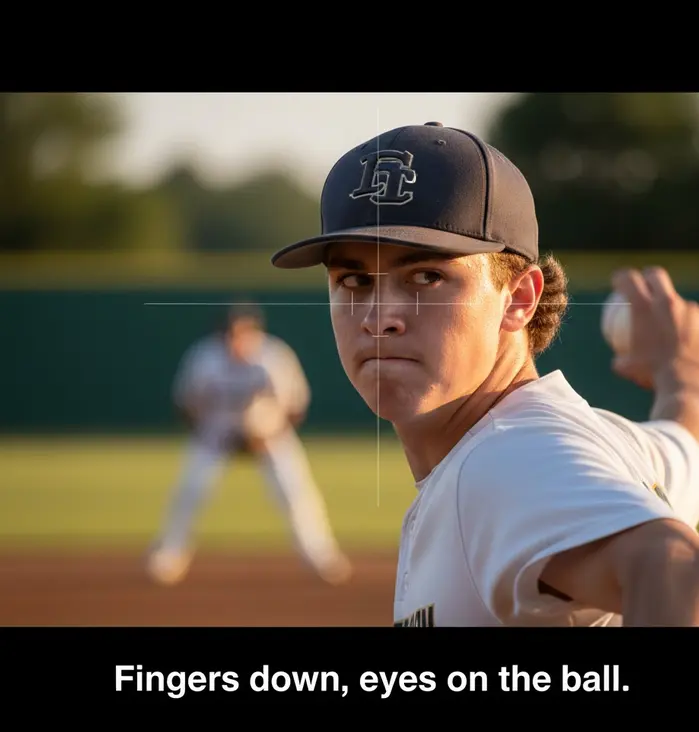
A stable head = A stable target.
Action Item: The “Level Eyes” Test
To master command, you must maintain a “Quiet Head” from the moment you lift your leg until the ball leaves your fingertips.
- The Horizon Line: Imagine a perfectly level horizontal line cutting through the catcher’s mask. Your eyes must stay on that line. If your head dips or jerks up, you’ve just lost your “lock” on the target.
- Nose to Glove: At the point of release, your nose should be pointed directly at your target. If your head is pulled toward the dugout (a common result of “flying open”), your eyes are forced to track the target from the corner of the socket. This ruins your depth perception.
The 2026 Accuracy Secret:
Many young pitchers miss because they “tuck their chin” too hard or look at the ground during their leg lift. Keep your eyes on the target throughout the entire delivery. If you lose sight of the mitt for even a split second, your brain has to “re-acquire” the target while your body is moving at max speed. That is a recipe for a walk.
10 Pitching Drills for Accuracy in Baseball
There are many pitching accuracy drills to do. But, another fact to be clarified is that all drills are not described here.
I have tried to let you learn the most basic and most popular ones which could be used for 8-year-olds drilling to adults.
Ok, let’s start with our next proceeds.
i. Warm-up Drill
If you are new to baseball, you should know that the pitching position is more injury prone than other positions in baseball. On the other hand, if you already know, you probably understand the sensitivity of the pitching position as well.

So, a regular warm-up would be just relieving for getting physical strength for pitching. Like you are warming up for the match, and warming up in the drills have differences.
Warming up in drilling will give you more freedom to do so as per your wish. So, you can make a regular routine to properly warm up.
One of the popular warm-up exercises you can do as a group or with your pitchers is jogging. Warming up properly and frequently lowers the chance of injury. Additionally, you will gain energy for your basic bodily movements.
As a pitcher, warming up pitching could be a great way to advance yourself in pitching. Aside from jogging, you can follow the following pitching warm-up exercises.
a. Pitching Warm-Up on Wall
This warmup is so simple. You will just need a mat, baseball or tennis ball, and a wall of your house or in your coaching facility.
If you use a wall for this warmup, the need for any assistance will be just removed.
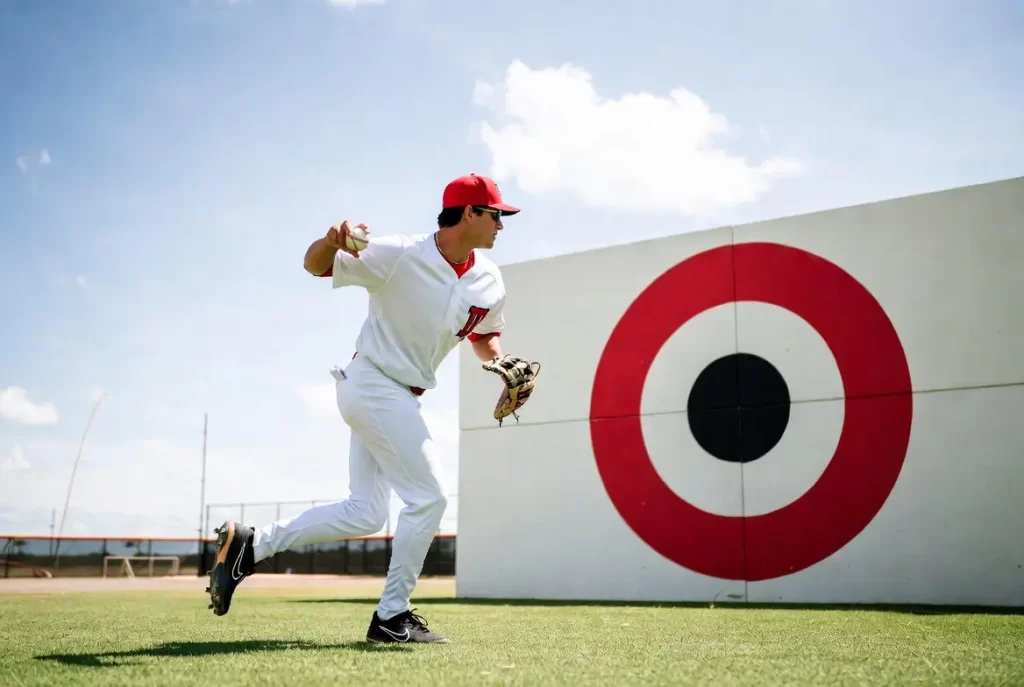
However, you need to kneel down on the floor on the mat and start with light movement. Just slightly rotate your body for a while. Make sure your arms are loosened up to throw the balls.
Now, you can start throwing first without a ball. Set your focus on, and try some more throwing without the ball.
After some empty-throwing, now you can use lighter balls for primary throwing. Throw the ball on the wall. Keep practicing for 3 to 5 minutes. Perform the same activity with another weighted ball as well.
Now, after having the reliability on two knees, you can now use just one kneed down and continue the process for further minutes.
Do this warm-up on a regular basis.
b. Warming Up with Rubber Band
As I have mentioned before, your muscles need to become relaxed from the stiff state. Rubber band pulling would be a great way to do so. For this warm-up, you will need a set of J-bands.
One of the great facts is, that the set of bands come with different resistance. As a result, you can exercise with different resistance states for loosening up your muscles. Also, the different states of your muscles will refrain.
You can do the following 3 basic bands warm-up with the bands.
- Standing rows in a split stance train your upper body, especially your middle back. Additionally, shoulders and biceps are mentioned.
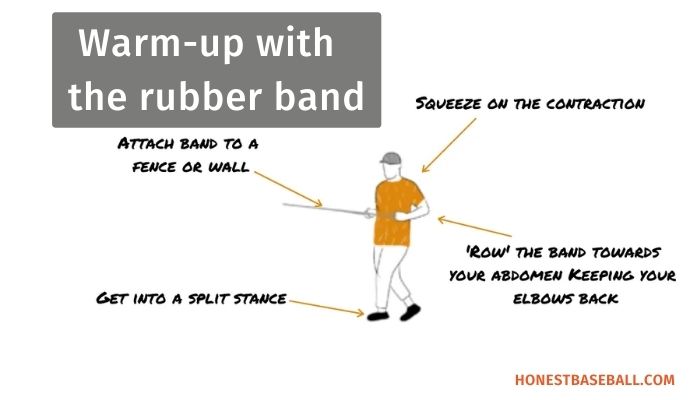
First, fasten the band to a wall or fence. Put your legs apart and bring the band straight up to your abdomen. Immediately pull your shoulder back. Repeat this multiple times.
- Now change your exercise to another one. Attach the band the same as the previous. You can call this band chest pulls. This exercise will work on your shoulders, elbows, and upper back.
This workout almost makes my face hurt. One hand should pull the band closer to your chest. Be sure to flex the shoulder muscles of both the hand you are pulling with and your own shoulders.
Consider your hand to be a hook, hold it in place, and let the elbow handle the tugging. Use the opposite hand to perform the same action. Keep the cycle running for at least 3 minutes.
- Your cuffs, shoulders, and upper back will benefit from this Cuban band rotator workout. Attach the band to a wall or fence in the same manner. Hold the band in your two hands while facing the band directly.
Maintain the band’s 90° angle to your shoulder for the whole workout. Allow pressure to be applied to the aforementioned body areas while you pull the band back to your shoulder.
ii. Balance Drill
Keeping balance is one of the most important aspects of pitchers. The improper balance will bring poorly thrown pitches that would experience rough and tough hitting.
As a result, runs come and this goes against the pitcher. To avoid such cruel hitting, keeping your pitchers balance is a must.
Ultimately as a coach, you should emphasize the balance drill for the betterment of the pitchers of your team.
You may follow the following three balance drills to solve the pitching control problems.
a. Push-Off Drill
Do you/your players feel stiffness while pushing off your foot? This might be developed with the push-off drill of feet. The push-off foot is the main catalyst of balancing off the entire body and gives the ultimate pace of the pitches.
However, you will find the drill just simple. Also, you can join this drill with other pitching drills together.
Your pitchers can be encouraged to put weight on their push-off foot. Let them elevate their knees in tandem with this.
Okay, there are now more things to do. Your pitchers may be guaranteed to maintain the same position for a few pitches.
In addition, a butt-fixing exercise might be performed.
b. Pitching Aim for Balance
This drill is heavily recommended for extreme balance control of the pitchers. Basically, these drills are aimed at younger players, especially beginners.
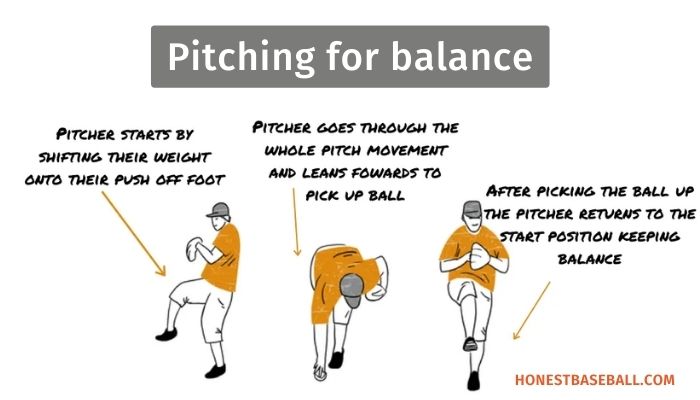
A ball is placed on the ground in front of the pitcher as the drill’s initial step. The pitcher then has to take up the ball by bending forward in an RDL motion.
The pitcher begins the motion by transferring their weight to their push-off foot. Then he/they completes the whole pitch motion and stoops to pick up the ball.
The pitchers must maintain their balance as they return to the starting position after picking up the ball.
c. Lead the Hold Pitch
The previous portion of the drill has been replaced by this one. By the way, the movement’s major impetus is your players’ butts. During this phase of the practice, you must make sure your participants are leading their butt correctly.
Take your pitcher and place him in front of a wall on the side that will release the pitch. Allow him to reach his knee. The sole remaining component at this point is the butt, which would cause the present tilt toward the wall.
Make sure the standing leg of the pitcher is slightly bent. Additionally, neither leg may rest on a wall. The butt is the only area that should contact the wall. Push the butt against the wall while scratching it.
iii. Pitching Velocity Drill
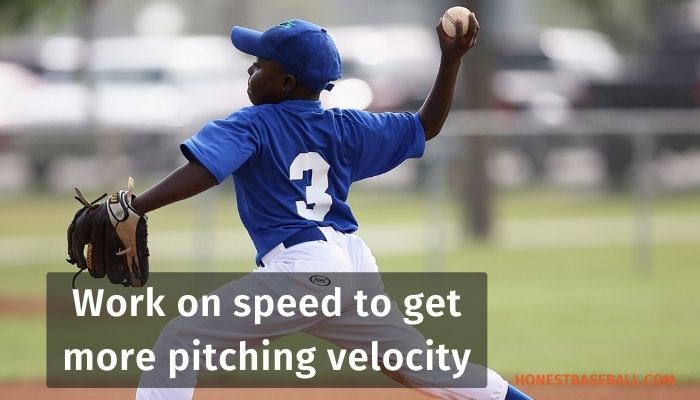
One of a pitcher’s best weapons is pitching velocity. Drilling is therefore essential to achieving tremendous pitching velocity when throwing the pitches.
Therefore, you must perform a throwing velocity workout if you want to increase your pitching velocity.
However, velocity is not the last word. Managing the pitches and your body movement is equally as crucial as controlling the velocity.
A terrific outcome would occur from a throw made at 85 mph if you can pitch at 85 mph with excellent balance and control rather than 95 mph. However, if you can additionally manage the faster pitching speed, this could be the best.
Therefore, as you can see, throwing at a high velocity with excellent control is ideal.
Practice increasing your velocity by doing so. Ensure that you have control of the ball so that you can position it any way you want, throwing the hitters off-balance.
hurl a tennis ball towards the wall with more force. As time passes, up the pace. Ensure that every pitch is optimized for control.
Pitching velocity development is for throwing fastballs. The two-seam fastball is a popular one among pitchers. You may follow our guide on “How To Throw A Two Seam Fastball (Learn From A Coach)” for learning properly throw the two-seam fastball.
iv. Mechanical Aspect development
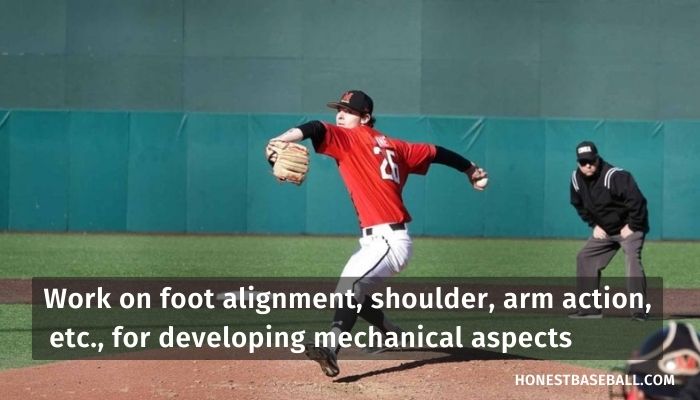
Figure 07- Work on foot alignment, shoulder, arm action, etc., for developing mechanical aspects
Fixing your pitcher’s mechanical strategy is one of the most important aspects of pitching. For this, you have to work with several attributes of your pitcher. There are a lot of things to work with as follows.
a. Pivot Foot Alignment
Verify that the pivot foot’s alignment matches the pitching rubber’s front. The pitcher’s horizontal control is impacted by this.
For right-handers, you must begin from the right side, according to the rubber pivot orientation. For lefties, there is also the left side.
In addition, if any right-hander discovers that his weakness is the fastball that tails inside excessively, he should correct this by shifting his start position a little bit closer to the middle of the rubber’s left side. Additionally, he must adjust the position of his pivot foot as well.
b. Square Up the Shoulder
Verify that the pitcher is throwing his pitches on the side of the rubber closest to his arm. Check to determine whether the strides are too close as well. If that’s the case, he must adjust his stance and lean toward the glove side.
This will assist in aligning the pitcher’s shoulder. As an outcome, the pitcher will be better able to control his pitches. Additionally, the number of repetitive deliveries will decline.
c. Foot Lifting Balance, Arm Action
For a delivery to be successful, the foot must be balanced. To effortlessly distribute his body weight evenly, the pitcher should practice balancing his foot. He won’t fall over when he raises his knee as a result.
Also, make sure your pitcher does not overrotate his body before he lifts up his knee properly. This will bring up a poorly thrown stride when he lands on the ground.
Let not pull back the pitcher’s hand too extensively behind the back. Also, don’t allow it too far from the body, too high or too low as well. Make sure the hand coordination of the pitcher stays in the center of the body.
Aside from these, make sure,
- The finger of the pitcher does not pierce the ball.
- Ensure that the pitcher’s arm is in a proper place.
- The body’s movement and pitching have equal timing.
- As the pitcher begins to predominantly shift his body toward the home plate where the hitters stand, make sure he leads the front hip after reaching maximum knee height.
- Let not allow the pitcher to open his shoulder too early. Otherwise, the pitcher may miss throwing arm side.
- Make sure the pitcher’s head and the throwing hand do not come too close.
- Make sure the pitcher doesn’t make the poor hip rotation.
- Correct the pitcher if his hand’s angle is too high. Also, make sure the pitcher’s head does not come to the throwing line.
v. Physical Conditioning

The significance of the pitchers’ healthy physical condition has previously been acknowledged. To be really honest, being in good physical shape is the key to performing well when pitching.
A pitcher’s performance is directly impacted by his physical health. Pitching is a strength-based sports activity, thus without adequate physical condition, the balls won’t get enough space or speed.
Therefore, as a coach, make sure your pitchers have been receiving excellent physical fitness. Make sure the pitcher has a good kinetic chain from the bottom half of the body to the upper part for strength. conditioning the growth of the striking zone.
All of these will aid in improving the body’s dynamic balance and excellent posture when tossing the ball to the batters. The properly-developed strength will help you to know how to hit your spots pitching.
Vi. Mental Health Process

Many people think baseball is just a game of tactics and physical strength. Just things are here to be explored more.
Games are not just all about physical activities, the psychological activities as well. Even, you may do poorly in many games even if you have strong physical and tactical abilities, but lack psychological or mental strength.
Let’s talk about some psychological facts that are impactful for the pitching and you have to roam to work with them in mental pitching drills.
a. Let Not Allow Your Pitcher to Waste Many Pitches
It’s a common phenomenon that pitchers give rebates often when they are ahead of the opposing team. Like if they are ahead of 0-2, 1-2, or something like that, sometimes they pitch wasted pitches.
They might toss a few foul balls, trash in the mud, trash in the air, etc. By now, they might be at ease. Here, the batters engage in psychological maneuvers.
By suddenly hitting the ball deep and moving up to the next base, they embarrass the pitchers.
In the end, pitchers shouldn’t lose in this position and should psychologically be ready to play their best the entire game.
b. Proper Concentration
Misconcentration will surely distract the pitcher’s attention, no doubt. In this case, the pitchers must be concentrative enough. To do so, the pitcher must block any type of distraction.
Work on focus improvement. Rather than being distracted a pitcher must work on how to throw the ball in the right place. Also, need to select the right pitch, and analyze the success probability of the pitch as well.
c. Handling the Stressful Situation
Situations can arise that might put mental pressure on the pitcher. Like he might take some harsh blows and receive some runs in retaliation. It’s a totally typical occurrence.
However, several pitchers were unable to handle the pressure and gave in. You must focus on such states in order to overcome such circumstances. Improve the pitcher’s ability to handle challenging situations mentally during pitching drills.
Encourage the athletes to be brave in these circumstances and to resist breaking in when the going gets difficult. Improve the emotional self-control of the pitchers. encouraging them to compete fiercely even under the most trying circumstances.
d. Keep Your Effort Under Your Ability
Since pitching is the most important activity of the defense team in baseball, the pitcher is the most important player too. The team depends on him in most cases.
As a pitcher, one should entirely know his responsibilities and duties on the baseball field. Throw your strongest pitch and dominate the hitters.
However, a pitcher needs occasionally to be aware of when to quit. A pitcher should be aware of his capabilities and limits in this instance of negativity. He ought to accept them in his own manner as well.
The pitcher also needs to develop his pitching skills and become more successful. A pitcher should refrain from doing anything over the top.
You also should work with this section in the pitching drilling psychologically. Make your pitchers understand what to do or what not in special sessions.
vii. Great Visualization

It’s important that a pitcher must follow every detail of the hitter. Where do the eyes of the pitcher go when he pitches? Upper, down, or side of the batter?
A survey on a pitcher says something. An American sports author Harvey A. Dorfman once asked a pitcher
“Do you know where your eyes go when you pitch?”
The answer was the pitcher looked at the target before every delivery.
After getting this answer, the pitcher immediately asked about the catcher’s glove color. But the pitcher didn’t remember the color.
This survey shows that concentration on the target for a long time burns out the catcher’s gear color in the pitcher’s brain. So, this is actually a great thing.
Make sure your pitcher focuses on the target every time while delivering the pitches to the otters.
However, if the pitcher’s eyes do happen to wander, make sure they immediately refocus as he raises his leg to throw the ball. “Leg up, eyes up” is an unwritten rule in baseball throwing.
Therefore, the pitcher’s attention should be fixed on the target as soon as he raises his leg to the highest point in preparation for the delivery.
The youth players could lose their heads while delivering the ball. The great visualization would be great as youth pitching drills for accuracy.
Because many pitchers pull down their heads immediately after delivering the pitch. In this case, the pitcher’s eyesight is lost. So, the pitcher should keep his head up so that he can track the ball immediately.
As a result, he would be able to field the ball that comes to him and defend himself.
Don’t Be Bothered with Baserunner’s Duplicity
As I have mentioned before the pitcher distracted with his eyesight would be suicidal. During the distraction period of the pitcher, the baserunner could try to distract and affect the control and vision of the pitcher.
It is because the pitcher’s eyes are mostly locked on the baserunner.
So, this should be considered and you should work on this phenomenon psychologically with your players either baseball or softball pitching drills for accuracy.
As a pitcher, you should work on this intensively so that the pitchers cannot be distracted. Even so, they should back to focus immediately.
Enhance the exercise on the drills and warm-up and make sure the pitcher only focuses on the target before and after the pitches he delivers.
viii. Pitching Drill for Stride
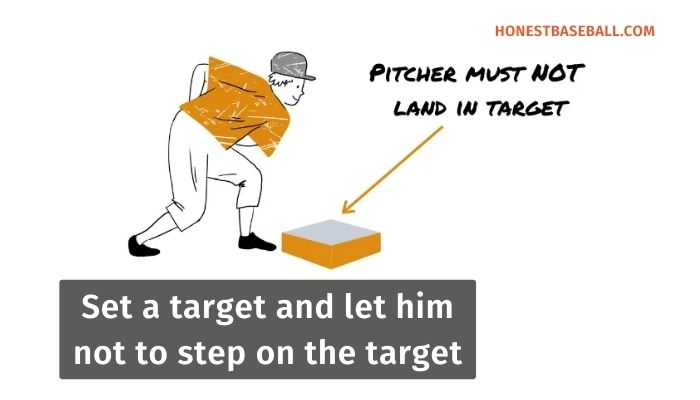
The attributes I have mentioned above can cause a wrong landing that the pitcher should. So, as a result, the hassles out of control could be on screen. Also, the smoothness will properly not be controlled and will be gone, no doubt.
By the way, you should correct this strategy of your pitcher. Make sure, the striding foot of the pitcher lands on the midline of the pitching rubber and the plate.
On the other hand, for too long and too short pitchers, the line could be different. Help them out to determine the exact targeted place on the line as per their height.
Youth players are always excited and want to do something that they cannot control. One of them is overstriding. As a result pitching control problems are here for the youth players.
So, the question is, how to improve pitching accuracy in baseball for the youth players?
Youth pitching drills for accuracy can take into account by monitoring and controlling the youth players’ overstriding.
Their tendency is to throw as far as possible and control is not ensured. But, you should encourage and motivate the players to focus on the target, not overstride.
To improve the overstriding state, you can put a target in front of the pitcher and let him allow not step on the target. The target could be a towel, mat, pad, or something else.
Let him first attempt the pitches empty hand. You cannot expect the final improvement in some of the first attempts.
After doing a couple of cycles, this should be improved. If so, now let the pitcher use baseball to pitch and monitor if he can prevent him from overstriding.
Heel Roll-Up Drill for Pitching
The heel roll-up drill is another exercise that causes the pitchers’ entire bodies to quiver. The body’s techniques and strength are enhanced by this, and more effectively transfer energy. The exercise ultimately improves the pitcher’s velocity and power.
The starting positions of the pitchers must be respected for this drill. Then, with their hands extended and their body weight slightly shifted to their rear leg, let them create a t with their bodies.
Let the pitchers finish the pitch after assuming their position by bringing their front legs across. Roll the rear heel somewhat as well.
By the way, you should practice this drill with several dry pitches. Allow your pitchers to utilize baseballs for practice once they have practiced dry throwing and become comfortable with the motion.
ixPitching Drill for Accuracy
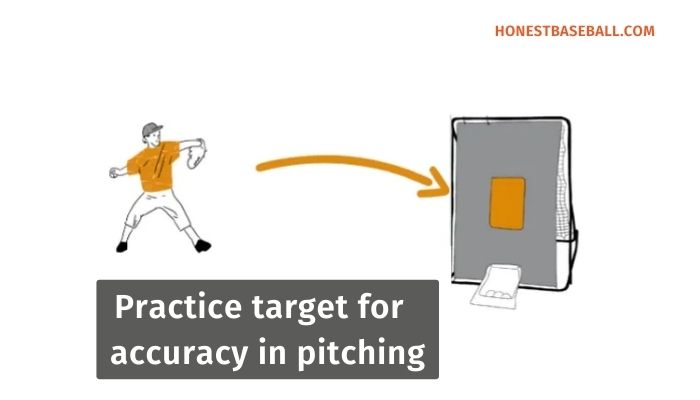
Our last but not least exercise is a pitching drill that trains the pitcher to hit the target with accuracy. Since you completed the exercises I’ve outlined, you may practice them all utilizing targets.
The pitchers’ ultimate goal is to strike out the target. During the drills, you can utilize a variety of target information on your processor.
The most common tool for this may be a target net. The target, by the way, could be of different sizes and forms. Choose one based on its dependability.
For your convenience, there are some baseball pitching targets mentioned below.
- PowerNet German Marquez Pitch Perfect Targets | Baseball Softball Trainer
- Rukket 5×5 Baseball & Softball Net | Practice Hitting, Pitching, Batting, and Catching
- VANTA SPORTS 4’x6′ Vinyl Backstop with Strike Zone and Catcher Image for Baseball/Softball
- GoSports Baseball & Softball Pitching Kit – Practice Accuracy Training with Strike Zone & Xtraman Dummy Batter
Beyond the Strike Zone: “Tunneling” for Elite Accuracy
In modern baseball, accuracy isn’t just about hitting the catcher’s mitt—it’s about Pitch Tunneling. If you throw a 75mph fastball and a 62mph changeup, but your arm speed or release point changes for each, the hitter will identify the pitch immediately.
Elite accuracy means your Fastball and your off-speed pitches look identical for the first 20 feet of the ball’s flight. This “shared path” is what coaches call the Tunnel.
1. The 20-Foot Rule
A hitter makes a decision to swing within the first 20–25 feet after the ball leaves your hand. If your accuracy is “true,” your changeup will come out of the exact same “window” (tunnel) as your fastball.
- The Goal: To have the hitter gear up for a fastball, only to realize too late that the ball has dropped out of the tunnel.
2. Accuracy vs. Arm Speed
The biggest mistake pitchers make when trying to be “accurate” with a changeup or curveball is slowing down their arm.
- The Result: The hitter sees the “slow arm” and knows a slow pitch is coming.
- The Fix: Your arm speed must remain 100% identical. Your accuracy comes from your release point and grip, not from “easing” the ball into the zone.
3. Sequencing: The “East-West” Strategy
Once you have mastered the tunnel, you use your accuracy to “sequence” pitches.
- The Setup: Throw a fastball on the inner half (Inside).
- The Finisher: Throw a slider or changeup that starts in that same tunnel but breaks to the outer half (Outside).
- The Result: The hitter’s brain is still reacting to the inside tunnel while the ball is actually moving to the outside corner.
Honest Baseball “Pro” Tip:
Don’t just practice hitting the same spot 10 times in a row. True “Sequence Accuracy” is being able to throw Fastball (High/Inside) followed immediately by Changeup (Low/Outside) while keeping your mechanics perfectly consistent. If you can do that, you don’t need 90mph to dominate a lineup.
Frequently Asked Questions
What is a good strike percentage for a high school pitcher?
Based on the difficulty of the games, the striking zone percentage fluctuates. However, in general, a strike percentage of 65 percent or more is excellent. whatever the grade. On the contrary, a rate of less than 58 percent is just subpar.
Therefore, a desirable strike percentage for pitchers is thought to be between 58 and 65 percent and above.
Should pitchers throw every day?
The Term “Practice makes a man perfect” is universal. So, why shouldn’t you practice daily if you want to become a great pitcher? Great pitchers in Minor League Baseball and Major League baseball spend at least 10 to 20 minutes daily with the balls.
Should pitchers lift weights?
Lifting weight is one of the effective ways to build up muscles. This also improves the strength of the pitchers. As a result, a pitcher can create more force and velocity while throwing the pitches toward the hitters.
Final Thoughts
The pitching drills for accuracy I have discussed in the post are not the last ones. There are many exercises you may implement for your pitchers in pitching drills.
However, practice makes a man perfect which is a universal truth. So, consistency of practice must bring success on the baseball field. Also, consistent practice enhances the skillset in an organic way.
You May Also Like:
7 Youth Baseball Hitting Drills – Hit To Stars Like A Pro!
Positions On The Baseball Field Explained By A Coach [Updated 2026]
Baseball Terminology | Honest Baseball
How To Play Baseball | Everything You Need To Know
Hello everyone. My name is Jason Butler, and I live in California, America. I was a professional AAA Minor League Baseball player. I lost my chance of playing MLB for injury issues, but I did not lose my love for baseball. I attended the coaching training program and am now working as a coach in a small school in San Diego.
I always love to share my experience and knowledge if that can help you. Play baseball, and stay fit.